Florida | Florida business continuity software
Storm readiness is not a matter of buying a cloud drive and hoping the office remains reachable. A Florida business can lose power, cellular coverage, building access and employee availability at the same time. A practical software strategy therefore starts with critical services: customer communication, orders, payroll, supplier coordination, records and the ability to authorize payments. The Florida Division of Emergency Management encourages business continuity planning that considers restricted access and limited communications. This guide translates that principle into a technology procurement exercise a small or midsize operator can actually run.
Rank business processes by time-sensitive impact
Ask each department which activities must continue the same day, which can wait several days and which can pause without material harm. For a coastal distributor, a missing dispatch board may immediately affect food delivery while a delayed marketing report may not. Record required people, applications, documents and third-party services for each task. This process becomes a business impact map, not a generic list of software brands. It also clarifies where an expensive high-availability subscription would provide value and where a documented offline procedure is more realistic.
Separate backup, synchronization and actual recovery
A synchronized folder can reproduce accidental deletion or ransomware encryption as quickly as legitimate edits. Ask vendors about version history, immutable or isolated copies where appropriate, retention windows and recovery privileges. Then test whether the business can restore a complete customer order or accounting ledger, not only download a random file. Establish recovery time and recovery point targets through practical discussion: how long can dispatch stop, and how much recent work can the team afford to re-enter? The answer should shape service choice, backup frequency and spending instead of relying on dramatic promises about perfect uptime.
Plan for unavailable offices and fragmented staff communications
A storm may leave a cloud system operational while employees cannot travel or charge their phones. Maintain several authorized communication methods, current emergency contacts, decision owners and a place to publish verified status updates. Test read-only access to essential procedures from an alternate location and decide which paper copies are still warranted. Consider how contractors or temporary staff receive instructions without exposing the entire customer database. The most sophisticated messaging platform fails a continuity test if all employees have forgotten the enrollment method or use it only from the inaccessible office.
Choose cloud vendors by dependency and geographic resilience
Study where critical data is hosted, which identity provider controls access and how a provider responds to a regional interruption. Geographic redundancy may be useful, but ask whether DNS, email, authentication, payment processors and support services share a single failure point. Keep a vendor contact sheet that is accessible independently of the affected account. Investigate how the company exports records when its subscription is temporarily unavailable, and whether administrative approvals require a person who may be offline. No architecture eliminates every hazard; the objective is graceful degradation with known decision paths.
Include cybersecurity in storm response
Disruptions create ideal circumstances for fraudulent invoice changes and phishing messages presented as emergency instructions. Agree on an out-of-band callback method for supplier bank changes, and keep MFA enabled even during a hurried relocation. Restrict emergency administrator accounts, log their use and revoke temporary access after operations stabilize. Test a scenario where a staff member receives a fake shipping update while responding from home. Business continuity and incident response belong in the same plan because an organization cannot afford to restore the wrong files from an untrusted backup during a crisis.
Budget for training, alternative access and exercises
The licensing quote rarely includes battery backup, secondary connectivity, data restoration assistance or employee time spent rehearsing procedures. Price those dependencies explicitly. A simple quarterly drill can test who declares an incident, how staff retrieve essential documents and whether finance can reconcile delayed transactions after service returns. Rotate participants so that knowledge does not concentrate in one manager. Record failures as useful feedback, then assign owners and due dates. Software should make preparedness more repeatable; it cannot substitute for a team that knows what to do when a routine process becomes impossible.
Measure resilience with customer outcomes
An exercise should evaluate more than whether a cloud login screen loaded. Count orders recovered, customers contacted accurately, supplier issues resolved, payroll interruptions avoided and decisions captured for later reconciliation. Also ask how long it takes a new employee to find a trusted version of the response plan. If staff fall back to unapproved personal messaging, the formal tool may be too cumbersome. Use those observations to simplify procedures and reduce the number of critical applications. During a hurricane, clarity and minimal dependencies usually matter more than an impressive list of integrations.
A practical buyer’s evidence checklist
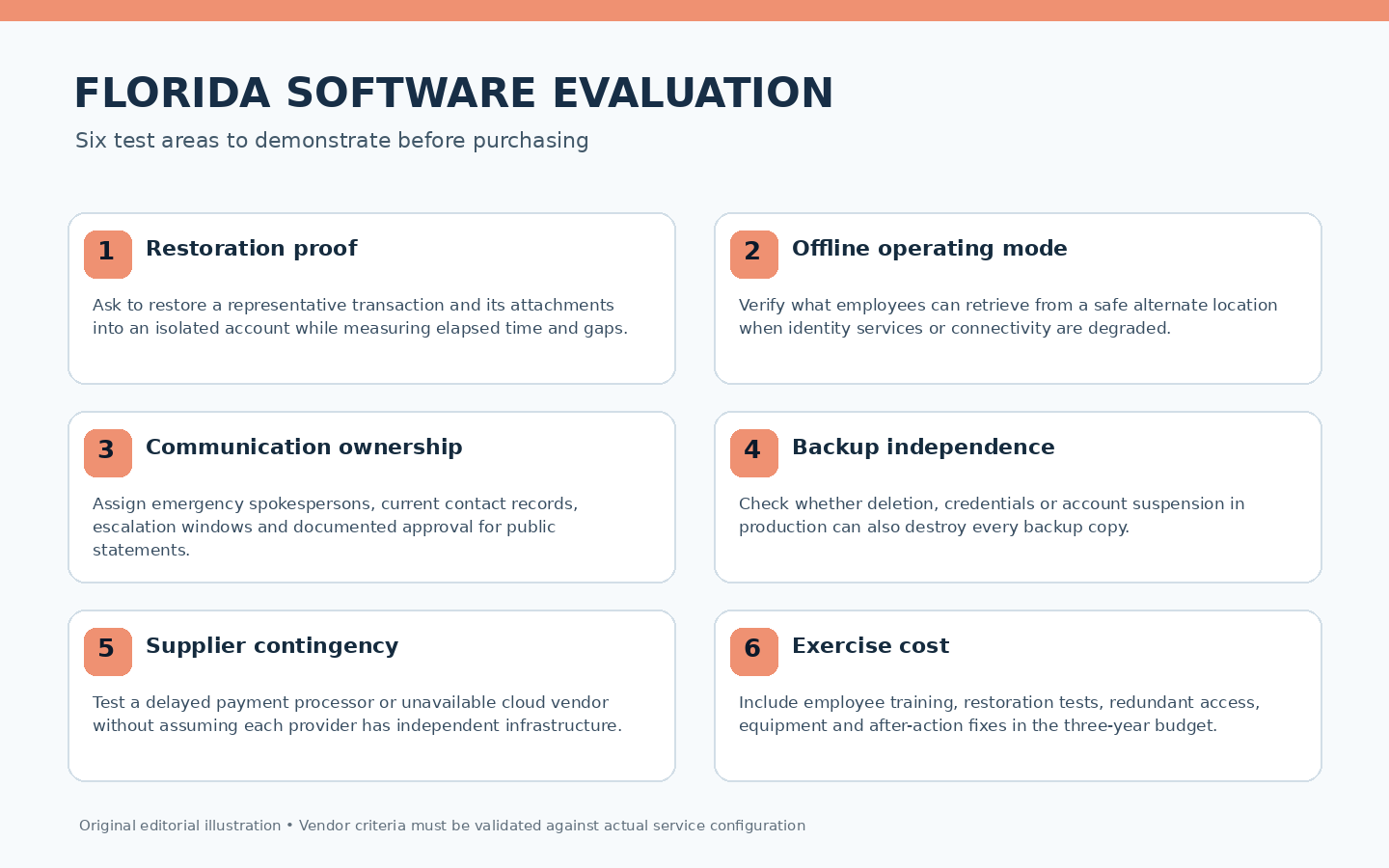
In Florida, evaluate Florida business continuity software with these six real-world trials and record vendor evidence.
1. Restoration proof
Ask to restore a representative transaction and its attachments into an isolated account while measuring elapsed time and gaps. Set a documented Florida acceptance criterion for restoration proof; preserve the supporting demonstration and its reviewer’s outstanding questions.
2. Offline operating mode
Verify what employees can retrieve from a safe alternate location when identity services or connectivity are degraded. Set a documented Florida acceptance criterion for offline operating mode; preserve the supporting demonstration and its reviewer’s outstanding questions.
3. Communication ownership
Assign emergency spokespersons, current contact records, escalation windows and documented approval for public statements. Set a documented Florida acceptance criterion for communication ownership; preserve the supporting demonstration and its reviewer’s outstanding questions.
4. Backup independence
Check whether deletion, credentials or account suspension in production can also destroy every backup copy. Set a documented Florida acceptance criterion for backup independence; preserve the supporting demonstration and its reviewer’s outstanding questions.
5. Supplier contingency
Test a delayed payment processor or unavailable cloud vendor without assuming each provider has independent infrastructure. Set a documented Florida acceptance criterion for supplier contingency; preserve the supporting demonstration and its reviewer’s outstanding questions.
6. Exercise cost
Include employee training, restoration tests, redundant access, equipment and after-action fixes in the three-year budget. Set a documented Florida acceptance criterion for exercise cost; preserve the supporting demonstration and its reviewer’s outstanding questions.
A worked purchasing scenario
A fictional Florida property-services company has a CRM, scheduling board and online invoicing portal. A storm warning arrives on Thursday. The owner verifies recent backup restoration, publishes a staff check-in instruction and exports tomorrow’s critical service calls to an approved offline pack. When the office closes, dispatch operates remotely, while nonessential marketing sends pause. Two days later a delayed mobile sync creates a duplicate service ticket; an administrator reconciles it using recorded job identifiers rather than deleting an uncertain entry. The plan is successful because customers receive consistent updates and the books remain explainable, not because the company avoided every interruption.
How to organize the evaluation workshop
Run a tabletop exercise in which the general manager announces that the main office will be inaccessible for seventy-two hours. Rather than discussing theoretical cloud uptime, ask the dispatch lead to locate tomorrow’s appointments, finance to identify outstanding payments and the owner to authenticate from an alternate device. Interrupt the simulated internet connection for a team member and test the approved fallback. Retrieve a customer contact record from backup into a nonproduction environment and compare the last transaction included with the intended recovery point. Role-play a fraudulent request to change a vendor’s payment details while the team is busy. Document who can authorize an emergency exception and who later reviews it. Afterward, turn the findings into a single-page call tree and a list of critical systems, with independent copies kept in more than one safe place. A continuity tool should make these drills easier to conduct, but the exercise must also prove that people know their responsibilities when every familiar office routine is disrupted.
Implementation, governance, and follow-up
A continuity technology decision should be organized around actual thresholds rather than general fear of storms. For each critical activity, specify how much delayed work would create lasting harm and which minimum information employees need to proceed safely. Identify the person who can announce a site closure, the backup decision-maker and the location of the current contact sheet. Ask what happens if the company email domain is unreachable while password resets depend on that same inbox. Test an administrator’s ability to recover access without bypassing sensible security controls. List external dependencies such as billing, banking, phone forwarding, fleet coordination and major suppliers; assign alternate communications wherever realistic. During a tabletop session, have a customer request an invoice correction when accounting is offline and decide whether the right response is to defer, use a controlled manual form or route the request elsewhere. Reconcile all deferred transactions after service returns. Evaluate whether the selected cloud vendor offers sufficiently usable versioned backups, support escalation and exports for the company’s needs. Then rehearse from a location that is not the main office. A practical plan should let someone unfamiliar with the system find the approved procedures, while leaving an audit trail of exceptional decisions made during recovery.
Once a platform is shortlisted, ask the vendor to explain service interruptions in terms employees can act on. What can a worker do if the login provider is unreachable? Which documents can be obtained from an approved alternate location? How does technical support authenticate an administrator whose usual device has been destroyed? These are not arguments for weakening security, but reasons to design recovery access before an incident. Agree on the process for restoring normal operations, including the reconciliation of manually recorded activity and closure of temporary permissions. During seasonal reviews, confirm that new suppliers and departing staff have not made the emergency contact information obsolete. Practical resilience is the sum of these small, verifiable decisions.
Questions buyers frequently ask
Is cloud storage the same as a disaster recovery plan?
No. Recovery also depends on access, identity, people, supplier availability, communications, priorities and verified restoration procedures.
Should every application have identical recovery targets?
Usually not. Rank services by operational consequences, then invest where interrupted activity would impose the greatest verified cost.
How often should a Florida business rehearse recovery?
Use a cadence that matches operational risk and seasonality; include a hands-on restoration and a communications exercise rather than reviewing a document alone.
Further reading and source notes
Primary references for Florida Florida business continuity software. Obtain case-specific professional advice and independently verify service terms.