Washington | Washington wellness customer data software
Appointment and client-management software for a Washington wellness business can look remarkably similar to a conventional booking app, while capturing information that deserves a very different level of care. A studio, fitness coaching operation or wellness service might ask about conditions, personal goals or other details that can enter the sphere of consumer health data. Washington’s My Health My Data Act addresses defined practices involving consumer health data and has specific terms and applicability considerations. This article is a software-buying framework, not a claim that every wellness platform is a medical record system or that every operator is subject to the same rule.
Separate booking necessities from sensitive intake questions
List what is truly needed to book a class, process a payment and contact a client. Then evaluate each additional intake field for a genuine service purpose, a safe access model and a retention decision. A simple appointment system should not automatically broadcast an answer about a health concern to front-desk staff, marketing tools or unrelated analytics providers. Consider a separate restricted workflow when sensitive details are necessary. The goal is to avoid collecting information merely because a vendor provides a convenient template; design forms around the smallest defensible set of data for the service offered.
Understand the Washington data boundary
The My Health My Data Act uses defined concepts for consumer health data and regulated entities, with important coverage, notice and permission provisions. Its relationship with HIPAA and other rules requires careful assessment; do not assume that being outside HIPAA means health-related information is unregulated. Have counsel inspect actual intake questions, inferred data, geolocation use and any integrations. In procurement meetings, ask vendors to identify whether health-related details appear in appointment notes, email campaigns, support logs or analytics events. A precise data inventory is more useful than a broad statement that the platform is ‘privacy compliant.’
Build meaningful staff permission levels
A receptionist may need to confirm arrival and payment without viewing coaching notes. An assigned service professional may need selected client context while an outside marketing contractor requires none of it. Demonstrate role-based records, field visibility, export restrictions and periodic access reviews. Check how shared front-desk devices end sessions between users. If a staff member moves to another location, their permissions should change without exposing every former client. Vendor support sessions should be approved and logged where appropriate. Sensitive records often leak through ordinary shortcuts, such as sending unredacted intake forms by general email.
Scrutinize analytics, messaging and advertising connections
A booking platform may advertise automatic retargeting or message personalization. Ask exactly what information is transmitted, which identifiers are attached and whether sensitive service inferences can appear in advertising systems. Keep appointment reminders separate from promotional flows and avoid designing campaigns based on health-related information without rigorous review. Test whether cancellation or a corrected profile prevents stale data from resurfacing in an audience export. The feature that increases campaign reach is not necessarily appropriate for a business that depends on client confidence and restrained processing.
Require dependable deletion and data retrieval procedures
Staff need a process to correct a mistaken intake answer, remove inappropriate notes and fulfill properly assessed requests without corrupting legitimate business records. Inspect retention configuration, archival access, backup behavior and what information remains in outbound integrations after a change. Request an example export containing appointments, consent or preference records and linked notes that the business is entitled to retrieve. Do not assume that clicking delete in one dashboard removes all copies held by third parties. Establish documented ownership for responding to clients and escalate complex cases for legal review.
Compare the operational software stack, not a single module
A wellness business might need scheduling, instructor capacity, billing, subscriptions, communications and staff coordination. Evaluate whether a unified product genuinely controls sensitive fields more effectively than a connected stack, and whether it can support cancellations, class credits and family bookings without unauthorized disclosures. Budget for onboarding, policy design, contract review, employee training and data migration. Prefer vendors that can explain their integration diagrams and offer a real administrative demonstration. A low sticker price can become expensive if the organization spends its time repairing privacy or scheduling errors.
Run an intake-to-departure test before going live
Build fictional clients with distinct booking needs and a clearly sensitive note, then trace how that information appears to the receptionist, practitioner, billing staff and marketing user. Test a rescheduled appointment, request to correct information, revoked access and export after a client stops using the service. Record who sees each event and why. This hands-on exercise identifies unintended disclosure more effectively than checking a box labeled secure. Use the findings to simplify forms and staff responsibilities before any real client information is migrated.
A practical buyer’s evidence checklist
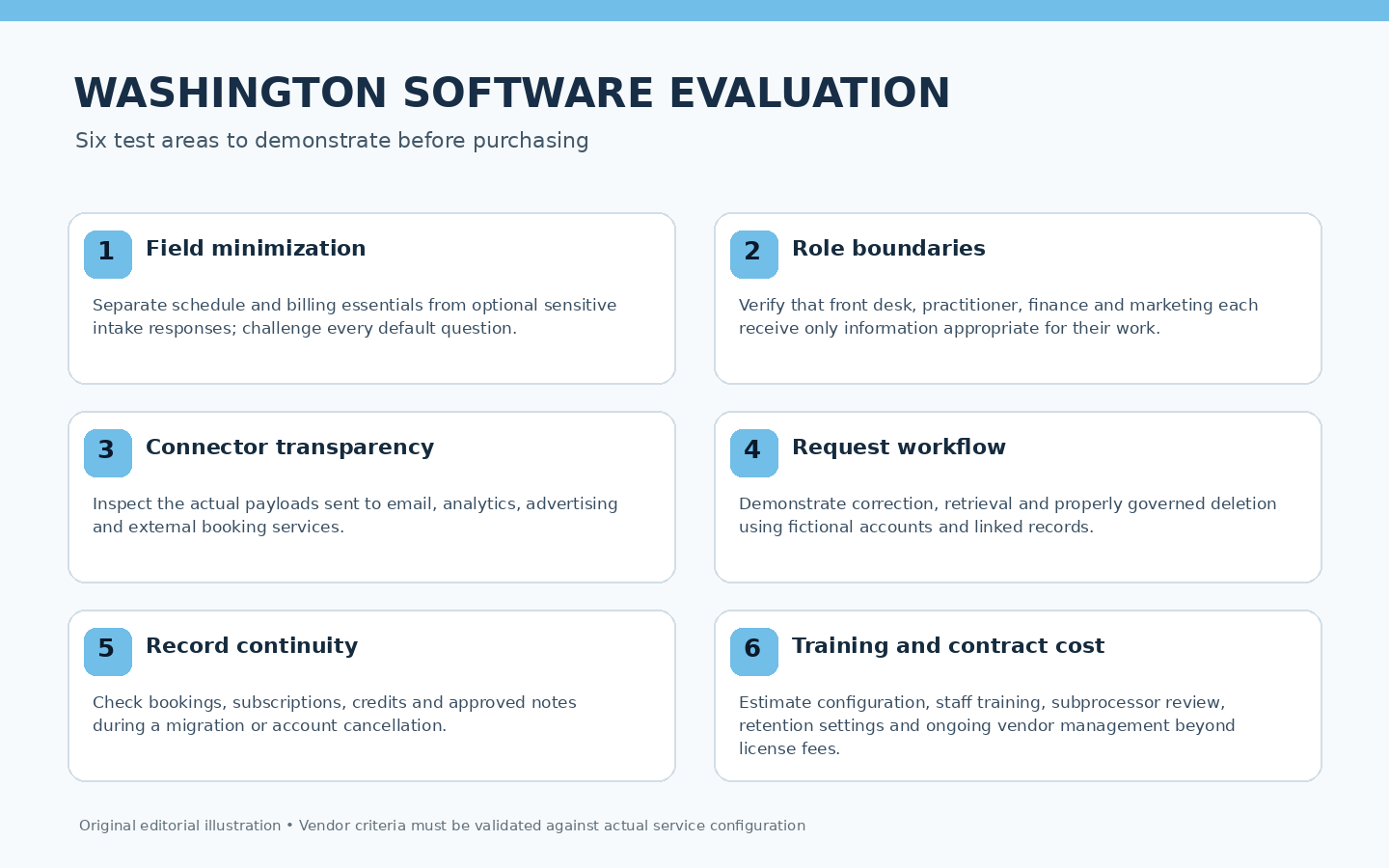
In Washington, evaluate Washington wellness customer data software with these six real-world trials and record vendor evidence.
1. Field minimization
Separate schedule and billing essentials from optional sensitive intake responses; challenge every default question. Set a documented Washington acceptance criterion for field minimization; preserve the supporting demonstration and its reviewer’s outstanding questions.
2. Role boundaries
Verify that front desk, practitioner, finance and marketing each receive only information appropriate for their work. Set a documented Washington acceptance criterion for role boundaries; preserve the supporting demonstration and its reviewer’s outstanding questions.
3. Connector transparency
Inspect the actual payloads sent to email, analytics, advertising and external booking services. Set a documented Washington acceptance criterion for connector transparency; preserve the supporting demonstration and its reviewer’s outstanding questions.
4. Request workflow
Demonstrate correction, retrieval and properly governed deletion using fictional accounts and linked records. Set a documented Washington acceptance criterion for request workflow; preserve the supporting demonstration and its reviewer’s outstanding questions.
5. Record continuity
Check bookings, subscriptions, credits and approved notes during a migration or account cancellation. Set a documented Washington acceptance criterion for record continuity; preserve the supporting demonstration and its reviewer’s outstanding questions.
6. Training and contract cost
Estimate configuration, staff training, subprocessor review, retention settings and ongoing vendor management beyond license fees. Set a documented Washington acceptance criterion for training and contract cost; preserve the supporting demonstration and its reviewer’s outstanding questions.
A worked purchasing scenario
A fictional Washington coaching studio replaces paper intake forms with online booking. The pilot creates two fictitious clients: one asks for routine scheduling reminders, while another supplies a sensitive note needed by the assigned coach. The studio discovers that the initial software role allows all front-desk employees to export every intake response. The vendor adjusts the configuration and marketing removes a broad audience-sync integration. A correction test then verifies that the coach sees the revised note while billing sees only payment details. The result is an operating process consistent with the organization’s actual need to know, subject to appropriate legal assessment.
How to organize the evaluation workshop
Construct an intake rehearsal that begins with a plain appointment booking, then adds information that a practitioner may reasonably need but a marketer should never see. Show the exact display for the receptionist, assigned service provider and billing employee; do not accept a narrated claim that permissions can be configured later. Send a fictitious appointment reminder and inspect the data that appears in the message payload. Test cancellation, amended notes and a client request concerning information held by connected systems. Ask the supplier to identify which company has access to backup copies and whether a new advertising module would automatically receive the existing customer list. Keep the legal review focused on the actual information and uses in the business rather than product category labels. The purchasing decision should also include ordinary commercial needs, such as scheduling waitlists, subscription credits and staff availability. An overly complex privacy solution that prevents staff from performing routine work can encourage unsafe side channels; usability is part of sound governance.
Implementation, governance, and follow-up
For a Washington-focused intake technology review, create separate screens for scheduling, sensitive notes, payment records and customer communications. Ask the vendor to show every person or service that can read those categories, including help-desk support and connected analytics applications. An appointment reminder should not inadvertently include unnecessary personal background information. Invite the assigned service professional to explain which data is necessary for safe service and challenge fields proposed only because a form template contains them. Test a fictitious customer who asks for a correction and later changes their communication preferences. The process should make a clear distinction between ordinary booking information and information that might meet relevant legal definitions of consumer health data. Observe what is included when staff export the appointment calendar for a temporary workspace. Review the commercial role of subscriptions, credits, cancellations and waitlists as well, since privacy and business operations must work together. Before purchasing, require clear supplier documentation about support access, retained copies and third-party integrations. The buying team should produce a small record map that ordinary employees can follow instead of relying on a legal statement divorced from the software’s actual behavior.
Training should use screenshots from the configured system, not generic vendor documentation that shows a different permission model. Staff need a clear answer to what belongs in a scheduling note, which questions require an appropriately governed intake channel and when to refer a data request to the designated owner. Evaluate whether the platform’s mobile notifications reveal sensitive information on a locked screen. During migration, keep the source forms available for a controlled reconciliation period rather than copying all historical notes without review. An implementation succeeds when both operational reliability and appropriate restraint in handling customer information are visible in daily behavior.
Questions buyers frequently ask
Is a nonmedical wellness company automatically exempt from health data rules?
No blanket assumption is appropriate. Relevant state-law definitions and the organization’s actual data practices should be reviewed.
Can one booking platform manage every sensitive workflow?
Possibly, but only if permissions, integrations, retention and field access meet the business’s needs. Separate systems can also be appropriate when deliberately governed.
What is a useful vendor demonstration?
Follow a fictional client from intake through appointment, reminder, correction and departure while observing every role and downstream system.
Further reading and source notes
Primary references for Washington Washington wellness customer data software. Obtain case-specific professional advice and independently verify service terms.