Virginia | Virginia SaaS vendor selection
A Virginia consulting, engineering or business-services firm rarely buys software in isolation. A document platform might receive client contracts, a CRM holds relationship histories, a project system tracks confidential deliverables and an accounting suite supplies financial context. Every additional vendor introduces a dependency that needs an owner. A sound procurement process starts with the specific work the application must improve and the information it will touch. State privacy obligations may be relevant to certain organizations and data processing, but every firm benefits from disciplined supplier assessment regardless of whether a particular threshold is met.
Define the service outcome before inviting sales demonstrations
Write three jobs that the new product must perform: prepare client onboarding, approve a deliverable and close a completed project, for example. Specify who starts each job, how success is recognized and which records must stay linked. Invite vendors to demonstrate those scenarios rather than their entire product portfolio. A consultant might value searchable version history and externally shared folders more than an AI assistant that cannot cite its sources. Put mandatory capabilities beside optional conveniences and describe the circumstances that would disqualify a tool. This framing prevents purchasing a broad platform that solves an attractive but peripheral problem.
Classify information and vendor operational roles
Distinguish public marketing material, routine business contacts, client-confidential files, employee information and sensitive data subject to specialized duties. Virginia’s Consumer Data Protection Act has defined applicability conditions and exemptions, including limits tied to the number of relevant consumers or certain revenue characteristics. Avoid assuming every business-contact record is covered in the same way as consumer data. For any applicable processing, evaluate controller-versus-processor responsibilities with counsel and confirm that vendor contracts describe instructions and assistance. In everyday operations, assign who may share, correct, retain or export each class of information.
Investigate identity, privileged access and collaboration controls
Professional services firms often invite temporary collaborators. Test whether an external reviewer can access one engagement without searching every client, whether links expire and whether access is removed when a project ends. Compare MFA, single sign-on, approval workflows, support impersonation controls and logs for downloaded documents. Ask what happens to access when someone changes departments or a subcontractor leaves. A glossy security summary cannot replace a demonstration of a misconfigured shared folder and the process to discover and repair it. Least-privilege access should be achievable without creating an IT ticket for every normal collaboration.
Inspect integration ownership and hidden implementation labor
A new application may appear inexpensive until somebody must map client IDs among CRM, project tracking, email, accounting and file storage. Document which platform creates each record, what happens when a user changes a field and where failed updates are reported. Require sandbox or staging access for high-impact connections. Budget staff time for cleaning data, writing access policies, testing exports, training reviewers and revising client-facing templates. Do not purchase the hypothetical productivity gain before assigning these actual implementation tasks. A narrower system with a dependable connection may outperform a comprehensive suite that introduces multiple competing sources of truth.
Assess contractual exit and service interruption
Ask for usable customer-data exports, attachment retrieval, deletion timelines, support escalation and the practical effect of license nonpayment or temporary suspension. Firms working on long projects should test whether access to old deliverables survives the departure of the original account owner. Review indemnities, confidentiality provisions and breach communications with qualified advisors instead of adopting vendor boilerplate uncritically. An effective exit plan identifies not only how data leaves but how employees will find it in the replacement service. The vendor is a business dependency, and negotiating leverage is strongest before the company migrates its entire operating history.
Build a weighted evaluation with evidence
Select weights based on the firm’s activity instead of copying a public top-ten list. Client segregation, version control and usable search might outrank template design for one practice; regulated document approvals might dominate another. Score products only after seeing the same demonstration scenario with the same test data. Ask procurement to document caveats, product-tier limits, exceptions and which promises appear in the contract. Run a budget sensitivity test using a plausible increase in collaborator accounts and storage. State any assumptions in the final recommendation so leadership can see why the ranking could change.
Conduct a controlled first-client rollout
Choose one willing internal team and synthetic or appropriately approved records before expanding into live engagements. Define how incidents, access requests and workflow changes will be reported. Give employees a clear fallback when the new tool cannot handle a special case, rather than allowing private file-sharing accounts to proliferate. Review metrics such as document approval delay, duplicate client creation, search success and tickets raised by external reviewers. A go-live should conclude with an export test and a named system owner. The best software procurement result is an understandable operating model, not merely a successful invoice payment.
A practical buyer’s evidence checklist
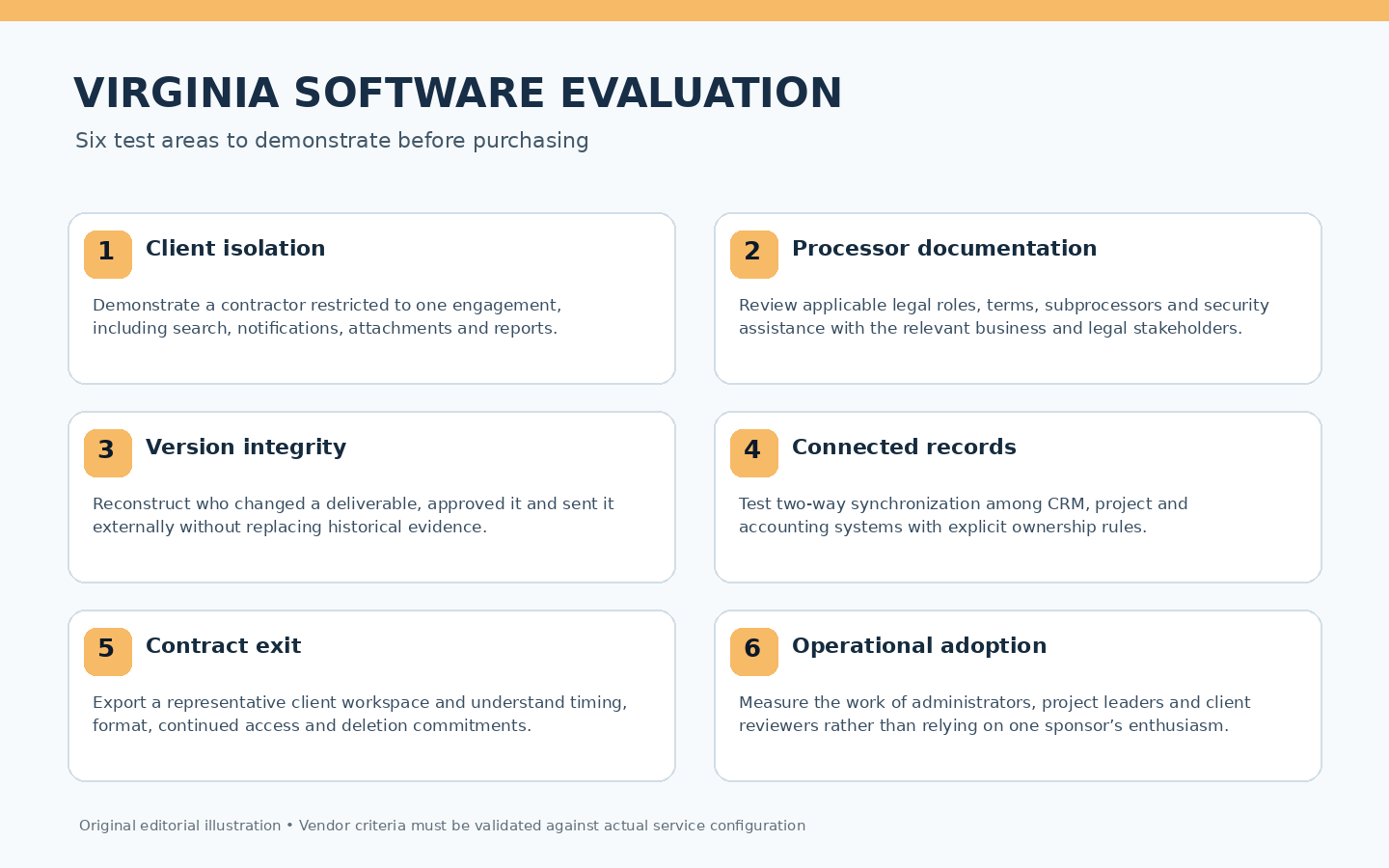
In Virginia, evaluate Virginia SaaS vendor selection with these six real-world trials and record vendor evidence.
1. Client isolation
Demonstrate a contractor restricted to one engagement, including search, notifications, attachments and reports. Set a documented Virginia acceptance criterion for client isolation; preserve the supporting demonstration and its reviewer’s outstanding questions.
2. Processor documentation
Review applicable legal roles, terms, subprocessors and security assistance with the relevant business and legal stakeholders. Set a documented Virginia acceptance criterion for processor documentation; preserve the supporting demonstration and its reviewer’s outstanding questions.
3. Version integrity
Reconstruct who changed a deliverable, approved it and sent it externally without replacing historical evidence. Set a documented Virginia acceptance criterion for version integrity; preserve the supporting demonstration and its reviewer’s outstanding questions.
4. Connected records
Test two-way synchronization among CRM, project and accounting systems with explicit ownership rules. Set a documented Virginia acceptance criterion for connected records; preserve the supporting demonstration and its reviewer’s outstanding questions.
5. Contract exit
Export a representative client workspace and understand timing, format, continued access and deletion commitments. Set a documented Virginia acceptance criterion for contract exit; preserve the supporting demonstration and its reviewer’s outstanding questions.
6. Operational adoption
Measure the work of administrators, project leaders and client reviewers rather than relying on one sponsor’s enthusiasm. Set a documented Virginia acceptance criterion for operational adoption; preserve the supporting demonstration and its reviewer’s outstanding questions.
A worked purchasing scenario
Consider a fictional Virginia engineering consultancy selecting a portal for twenty ongoing projects. Its proof of concept includes confidential drawings, client comments, revision approval and an external subcontractor whose access ends on Friday. One shortlisted product has superb visual presentation but places all client folders under a broad permission group; another offers narrower roles and a traceable approval chain. Procurement exports a sample project, calculates onboarding labor and obtains written terms for incident reporting. The team chooses on the basis of defensible collaboration and total operating cost rather than a headline license discount that omits guest access.
How to organize the evaluation workshop
Ask the shortlisted SaaS providers to open a fictional client engagement containing a proposal, a protected draft, an approval request and an invoice reference. Give the external reviewer a narrowly scoped account and ask the internal administrator to demonstrate exactly how access expires when the project ends. Then deliberately introduce a document version conflict and examine what the audit trail preserves. The finance lead should trace client identifiers between project and accounting systems, while the security reviewer checks support access and incident escalation. Procurement requests a representative data export using the vendor’s normal process, including the expected fees and turnaround time. Have a different employee use that export to locate the approved deliverable without help from the selling vendor. The committee should log hard failures, configuration workarounds and contractual gaps separately; otherwise, a workable setting can disguise a promised capability that is not actually included in the selected product tier. The final buying memo should name the owner of every critical integration.
Implementation, governance, and follow-up
A useful vendor selection memorandum should explain not only the winner but also the business’s exposure if the chosen platform fails. Ask who administers shared client spaces, who approves external accounts and who owns contract renewal. Have procurement verify the quoted service tier against the features actually demonstrated. Introduce an external reviewer whose email domain changes and verify how access is reauthorized. Create an internal report containing two sensitive engagements and test whether a limited user can obtain it through global search. Ask the vendor for a clear description of export structure, attachment retention and technical assistance on exit. If an integration fails, the team should know which application remains authoritative and how a backlog is reconciled. Include training time for both employees and guests in the budget because customer-facing collaboration may require more support than an internal deployment. Confirm that incident notifications reach more than one authorized company contact. Finally, assign a named product owner who will review roles, connected applications and redundant accounts during routine operations. Procurement should leave the company with a documented service model it can govern, rather than a suite of features it does not fully understand.
When leadership approves the purchase, make the recommendation conditional on resolving its most material open risks. An implementation plan should name the owner of client permissions, the source of truth for engagement records and the process for deactivating guest accounts. Ask finance to model the price when a project requires more external reviewers than expected, and require documented export rights before migration. A vendor can change its feature packaging over time, so record the contractual commitments that influenced the decision. Conduct an early post-launch review of search restrictions and collaboration history; those controls are easier to correct when the number of live engagements is still small.
Questions buyers frequently ask
Does the VCDPA apply to every Virginia professional services company?
No. The statute includes scope conditions and exemptions; evaluate the actual organization, records and covered processing with counsel.
Is SOC reporting enough to approve a SaaS vendor?
A report can be useful evidence but does not replace reviewing the specific service configuration, contract responsibilities, access controls and data export.
How long should a trial last?
Long enough to exercise the full process, including a changed record, external collaboration, a failed integration and a representative export.
Further reading and source notes
Primary references for Virginia Virginia SaaS vendor selection. Obtain case-specific professional advice and independently verify service terms.