Illinois | Illinois time tracking biometric privacy software
An employee time clock may appear to be a narrow payroll purchase, but an Illinois employer evaluating fingerprint, face or hand-geometry features needs to consider a wider set of responsibilities. The state’s Biometric Information Privacy Act addresses covered collection, notice, written release, retention and destruction practices. Not every camera or ordinary photograph necessarily falls within the statute’s defined terms; legal analysis is fact specific. Meanwhile, managers still need dependable shifts, overtime controls, approvals and payroll exports. The right buying process compares privacy-preserving options alongside wage-record accuracy rather than treating biometric hardware as the default.
Decide whether biometrics solve a real problem
Begin with the attendance problem: incorrect punches, shared credentials, location disputes or a queue at shift change. Then examine alternatives such as PINs, employee badges, supervised check-in and mobile time entries under appropriate policies. A biometric scanner may reduce one type of fraud while creating a sensitive data lifecycle the employer did not previously manage. Ask each provider exactly what is captured, whether templates or images are stored, who controls the information and which processors receive it. A claim that a device stores ‘only math’ does not settle the legal or security analysis; request clear technical documents and legal review.
Review Illinois-specific notice and retention obligations
BIPA Section 15 includes requirements concerning a publicly available retention schedule and destruction guidelines, and provisions for written notice and release before certain biometric information is obtained. The details matter, including the categories of information involved and the statutory definitions. A software vendor cannot supply blanket legal permission through a settings toggle. If the employer chooses a relevant biometric workflow, it must identify the party responsible for notices, records, policy publication, employee questions and deletion when the applicable purpose or retention period ends. Have counsel verify the precise implementation and current legislative changes.
Give payroll an explainable record rather than raw punches
Accurate timekeeping requires scheduled shifts, actual clock events, meal periods, corrections, approval status and export history to remain distinguishable. A supervisor may need to amend a mistaken entry, but the original event should stay attributable. Test a shift crossing midnight, a worker temporarily assigned to another location and an employee disputing a missing clock-out. The system should support documented review instead of silently adjusting worked hours to match a roster. Align payroll calculations and record retention with advice from an Illinois wage-and-hour specialist rather than relying on software defaults advertised for all fifty states.
Control the mobile and shared-device experience
When staff clock in from a shared kiosk, check whether the previous employee’s identity or details remain visible. On mobile devices, consider location collection, consent where appropriate, access permissions and the treatment of personal phones. Test losing a kiosk or removing a manager’s access while payroll is pending. Employee information should flow only to parties with a defined need; scheduling managers rarely require unrestricted access to sensitive identity material. If a vendor uses subcontractors for identity or cloud services, obtain a useful description of that processing before rollout.
Build an accountable correction and dispute channel
A reliable time system must accommodate human mistakes without turning every complaint into an IT ticket. Document who reviews punch disputes, which evidence can be considered and whether an employee can see a corrected record before payroll closes. Preserve approval timestamps and change reasons. If the system sends alerts about unusual activity, validate the false-positive rate with a real shift pattern. Automated suspicion based on location, facial recognition or an anomalous schedule should not replace a fair review process. Consider whether a less intrusive feature can deliver the same managerial benefit.
Negotiate deletion, export and vendor termination
Ask how the business retrieves payroll records and attendance histories when it changes providers, while separately addressing any biometric identifiers or information. Request the vendor’s process for deletion requests, backups, contractual retention and end-of-contract certification. Determine whether account cancellation removes access to records that the employer still needs for legitimate retention obligations. Include breach-response responsibilities, support access, authentication and service-level escalation in contract review. A credible provider should be able to explain where a time event travels and what happens after an employee leaves.
Pilot at the busiest shift transition
Run one pay-period rehearsal using fictional identities and realistic shift variations. Include forgotten badges, late approvals, an overnight schedule, a disputed break and a device outage. Compare the effort required for workers, supervisors and payroll administrators. If biometric options are being considered, pilot the non-biometric pathway as a legitimate alternative rather than a broken fallback. Evaluate the data burden and employee communication cost alongside subscription and hardware prices. The strongest implementation is accurate, explainable and proportionate to the actual business problem.
A practical buyer’s evidence checklist
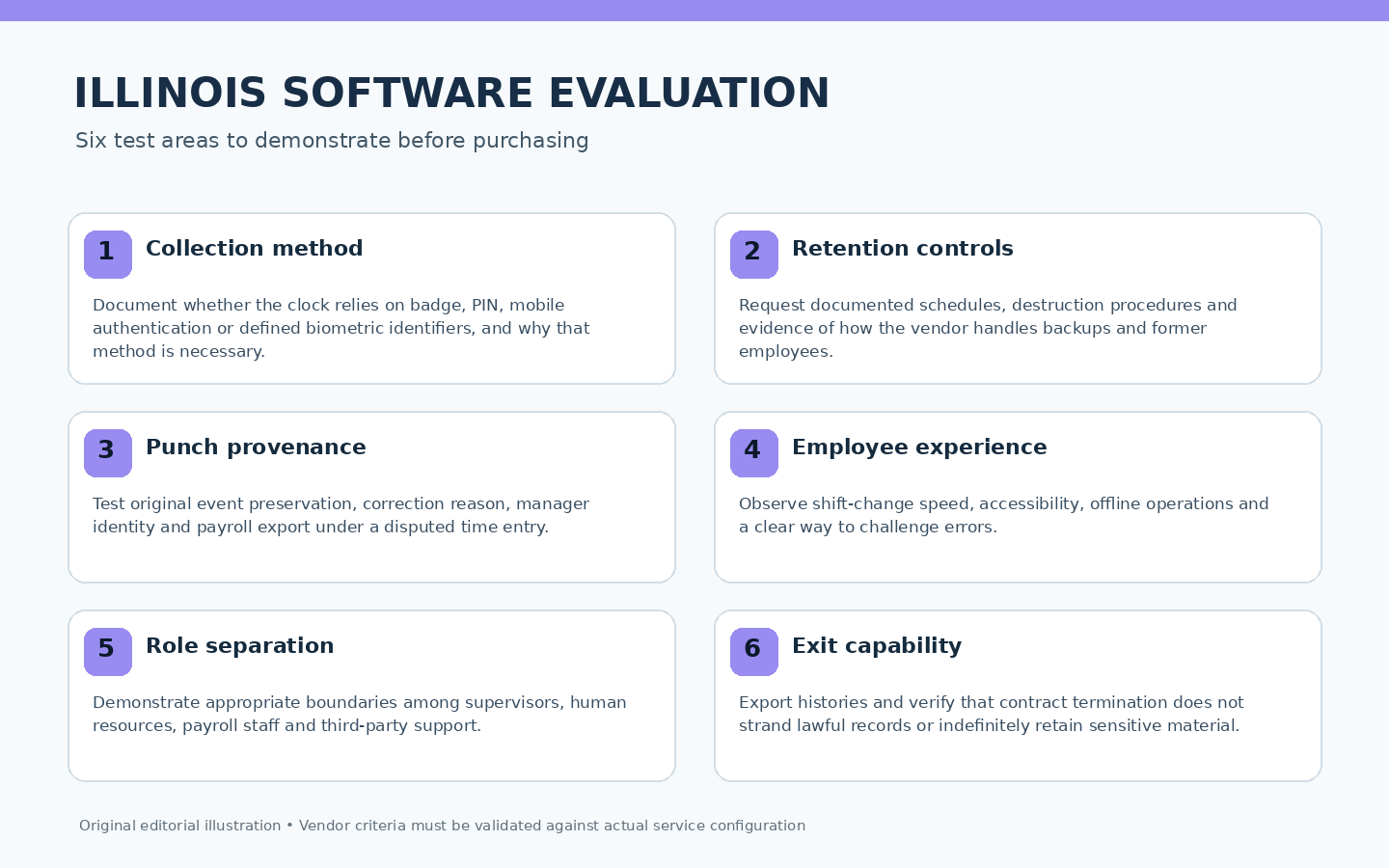
In Illinois, evaluate Illinois time tracking biometric privacy software with these six real-world trials and record vendor evidence.
1. Collection method
Document whether the clock relies on badge, PIN, mobile authentication or defined biometric identifiers, and why that method is necessary. Set a documented Illinois acceptance criterion for collection method; preserve the supporting demonstration and its reviewer’s outstanding questions.
2. Retention controls
Request documented schedules, destruction procedures and evidence of how the vendor handles backups and former employees. Set a documented Illinois acceptance criterion for retention controls; preserve the supporting demonstration and its reviewer’s outstanding questions.
3. Punch provenance
Test original event preservation, correction reason, manager identity and payroll export under a disputed time entry. Set a documented Illinois acceptance criterion for punch provenance; preserve the supporting demonstration and its reviewer’s outstanding questions.
4. Employee experience
Observe shift-change speed, accessibility, offline operations and a clear way to challenge errors. Set a documented Illinois acceptance criterion for employee experience; preserve the supporting demonstration and its reviewer’s outstanding questions.
5. Role separation
Demonstrate appropriate boundaries among supervisors, human resources, payroll staff and third-party support. Set a documented Illinois acceptance criterion for role separation; preserve the supporting demonstration and its reviewer’s outstanding questions.
6. Exit capability
Export histories and verify that contract termination does not strand lawful records or indefinitely retain sensitive material. Set a documented Illinois acceptance criterion for exit capability; preserve the supporting demonstration and its reviewer’s outstanding questions.
A worked purchasing scenario
An Illinois manufacturer with eighty staff is replacing a badge-based clock because employees frequently forget cards. A vendor proposes fingerprints and promises that payroll errors will disappear. The review committee compares the biometric offer with supervised PIN check-in, mapping operational savings against information-handling duties. In a sample pay period, one overnight worker misses a punch and a manager corrects the record while preserving its history. The employer asks counsel to review its contemplated data collection before deciding on hardware. The software wins only if it makes ordinary payroll reliable and the chosen method’s obligations manageable, rather than offering a feature that was never required.
How to organize the evaluation workshop
Invite payroll, operations, human resources, an employee representative and appropriate legal counsel to the requirements workshop. Start with the least intrusive attendance method that could address the actual errors. For each proposed technology, list the information collected at clock-in, where it travels, who can retrieve it and when it is removed under applicable rules. Create a simulated schedule containing a split shift, disputed break, missed punch and supervisor correction, then run payroll without erasing the original events. Ask workers whether the clock is accessible and whether its error messages clearly explain how to request help. For any biometric proposal, require specific vendor documents rather than making a decision on a promise that ‘nothing sensitive is stored.’ Test an employee departure and an end-of-contract export separately; each can expose overlooked access or retention behavior. The final approval memo should distinguish proven timekeeping gains from speculative fraud prevention and state why the selected information-collection method is proportionate to the problem.
Implementation, governance, and follow-up
A timekeeping procurement committee can set a practical threshold for acceptable employee friction. Observe the busiest shift change and compare badge, supervised PIN and other suitable approaches using the same workforce pattern. If a supplier proposes a biometric option, require the employer to obtain a description of what is technically captured and retained before consulting on obligations. Run an audit of who can see raw data, who can change time entries and who can approve a payroll export. Have a worker challenge a missed break, then measure whether the correction process protects the original event and records the reason for adjustment. Ask how the system deals with a power failure at the time clock and the order in which queued punches synchronize. Have payroll calculate a sample overnight and cross-location shift using rules supplied by the company’s qualified professionals rather than accepting an unverified default. Review whether temporary worker accounts and departing employee records are handled consistently with the written procedure. Document alternative check-in methods for staff who cannot use a particular device. Before signing, ask the vendor to export a complete synthetic pay period and explain its support role in correcting a payroll discrepancy. A defensible purchase is one whose documented operations remain understandable to employees and auditors alike.
Procurement should resist treating employee convenience and employee privacy as opposing goals. Clear error handling, an accessible check-in method, documented corrections and a limited data model can improve both. Require vendor support to explain what happens when a time clock is replaced, a worker transfers sites or an administrator mistakenly deletes an account. Determine whether the business can retrieve original punch events for legitimate review without receiving more personal information than necessary. A rollout communication should tell employees what the system does, how they report errors and where to raise concerns. For legal issues, retain qualified professional guidance rather than using an online vendor’s generic settings as a substitute for a tailored assessment.
Questions buyers frequently ask
Is every digital time clock a biometric system?
No. The relevant data and processing method matter. Review definitions and technical details rather than assuming all mobile or kiosk clocks are equivalent.
Can a vendor consent form replace employer review?
No. A vendor template is one input; employers should assess the actual collection, notice, retention, contract roles and current legal requirements.
What is the most important audit feature?
The ability to reconstruct original punches, adjustments, approvals and payroll exports without silently overwriting a worker’s history.
Further reading and source notes
Primary references for Illinois Illinois time tracking biometric privacy software. Obtain case-specific professional advice and independently verify service terms.