Massachusetts | Massachusetts secure document management software
A Massachusetts business may store client documents across laptops, shared drives, email attachments and a cloud portal without realizing how many uncontrolled copies exist. Choosing a document management product is therefore part of a broader information security program. Massachusetts regulation 201 CMR 17.00 sets minimum standards for organizations that own or license specified personal information about Commonwealth residents, including administrative, technical and physical safeguards. Applicability and particular facts should be reviewed with counsel. Software can support a written program through access control and evidence, but purchasing it does not by itself establish a complete program.
Inventory documents by sensitivity and owner
Organize records by their business purpose: contracts, identity documentation, invoices, employee files, project deliverables and routine reference material. Identify which collections contain information covered by applicable obligations and who approves sharing. A single all-staff drive may seem convenient but gives too many people access to records they do not need. Ask vendors to demonstrate classification labels, folder permissions, metadata, search restrictions and handling of downloaded copies. Choose naming conventions that employees understand. A classification scheme is valuable only if it guides everyday behavior rather than becoming a complicated form nobody completes.
Connect the technology plan to a written security program
201 CMR 17.00 addresses comprehensive information security program elements scaled to the organization and its information. A document platform should help the business execute designated ownership, access control, employee training, monitoring, incident records and service-provider oversight. Assign a real person responsible for periodic review and create a straightforward process for identifying exceptions. Ask what logs are available when an unusual download occurs, how access is removed when staff leave and which evidence supports a post-incident review. Treat policy writing and system configuration as coordinated work, not separate purchasing tasks.
Test encryption and secure sharing as specific behaviors
Marketing pages often say data is encrypted without explaining the scope. Ask how protected information moves over networks, what happens to copies on portable devices and which controls apply to shared links and external collaboration. Review the documented regulatory text and seek technical advice on implementation. Test an expired link, an unauthorized recipient and a worker attempting to retrieve a file after deactivation. Where necessary, select device-management controls to complement the cloud repository. Encryption is valuable, but a user who can export every file through a legitimate session can still create a major security failure.
Implement retention and defensible change histories
Some business records must remain available for legitimate operational or legal purposes, while unnecessary duplication expands risk. Assign retention by record class with professional guidance and verify whether the platform can preserve immutable or attributable histories where needed. A contract version should have a stable identifier, review comments, approval and a record of what was shared externally. Test legal holds and restoration if relevant to the firm. Clarify whether deleting a user also removes documents they created; employee departure must not destroy organizational information or leave it inaccessible to authorized successors.
Assess every service provider in the information chain
A document system may rely on cloud hosting, e-signature, OCR, backup and external identity tools. Massachusetts regulation includes service-provider oversight elements, so a sensible procurement file should describe which partners can access relevant information and what contractual safeguards are provided. Ask about subcontracted support, incident escalation, data return, deletion and changes in the processing chain. Confirm the business can export original files and their metadata without special professional services fees. Vendor due diligence should be sized to risk, but it should produce concrete answers rather than a folder of unexamined marketing brochures.
Calculate operational cost of secure collaboration
A cheaper file store is not necessarily a cheaper document operation. Account for indexing, external user licenses, identity integration, version retention, e-signature volume, migration and training. Measure the time employees spend finding approved contracts instead of emailing attachments titled final-v7. Test a client portal with limited permissions and compare how quickly staff can resolve a mistaken upload. The organization should define service goals such as fewer misdirected shares, faster document retrieval and traceable approvals. Those outcomes make a stronger buying argument than a generic promise of digital transformation.
Rehearse a lost laptop and a mistaken shared link
A realistic pilot includes two uncomfortable cases. First, a staff laptop containing synchronized material goes missing; the business must understand its device protection, remote access revocation and exposure assessment. Second, a project manager shares the wrong file with an external contact, and administrators need to revoke the link, inspect logs and document the response. Verify whether alerts are timely and whether logs contain information useful to people who will investigate. Finish with a sample restore and export. The winning platform is the one that helps an ordinary team practice secure behavior under stress.
A practical buyer’s evidence checklist
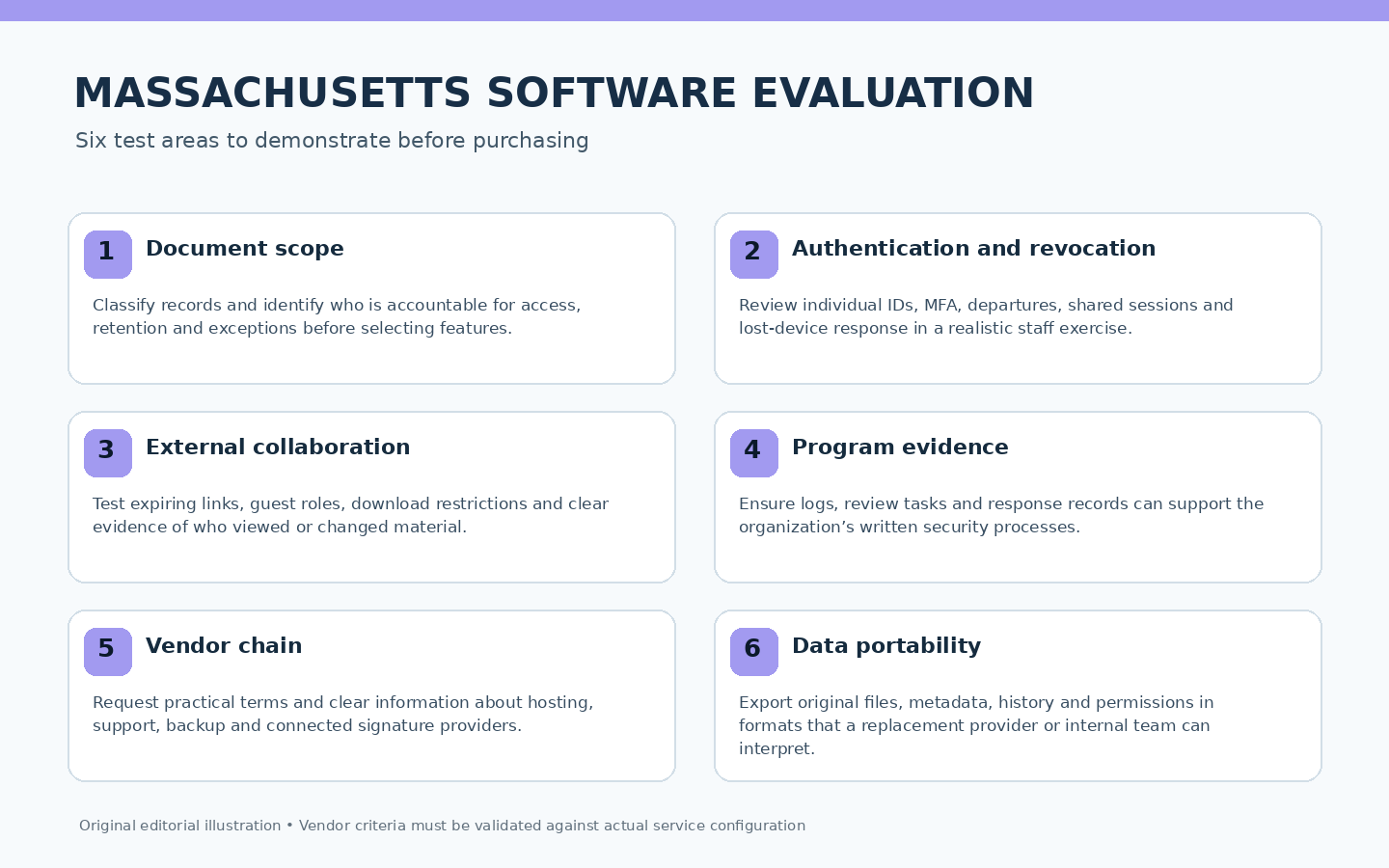
In Massachusetts, evaluate Massachusetts secure document management software with these six real-world trials and record vendor evidence.
1. Document scope
Classify records and identify who is accountable for access, retention and exceptions before selecting features. Set a documented Massachusetts acceptance criterion for document scope; preserve the supporting demonstration and its reviewer’s outstanding questions.
2. Authentication and revocation
Review individual IDs, MFA, departures, shared sessions and lost-device response in a realistic staff exercise. Set a documented Massachusetts acceptance criterion for authentication and revocation; preserve the supporting demonstration and its reviewer’s outstanding questions.
3. External collaboration
Test expiring links, guest roles, download restrictions and clear evidence of who viewed or changed material. Set a documented Massachusetts acceptance criterion for external collaboration; preserve the supporting demonstration and its reviewer’s outstanding questions.
4. Program evidence
Ensure logs, review tasks and response records can support the organization’s written security processes. Set a documented Massachusetts acceptance criterion for program evidence; preserve the supporting demonstration and its reviewer’s outstanding questions.
5. Vendor chain
Request practical terms and clear information about hosting, support, backup and connected signature providers. Set a documented Massachusetts acceptance criterion for vendor chain; preserve the supporting demonstration and its reviewer’s outstanding questions.
6. Data portability
Export original files, metadata, history and permissions in formats that a replacement provider or internal team can interpret. Set a documented Massachusetts acceptance criterion for data portability; preserve the supporting demonstration and its reviewer’s outstanding questions.
A worked purchasing scenario
A hypothetical Massachusetts architecture firm has fifteen employees, outside engineers and several years of client files. During its software trial, a designer accidentally shares a confidential document through a broad link. The team records how quickly it can identify recipients and revoke access, then checks whether the incident appears in usable logs. In a second test, an employee leaves and a successor must find project decisions without inheriting the departing person’s account. The product is considered viable only if these everyday scenarios align with documented organizational policies and the firm can recover records independently of the provider’s proprietary interface.
How to organize the evaluation workshop
Bring a sample of non-sensitive project documents to the vendor demonstration, including drafts, approved versions, client correspondence and a file that should be available only to one engagement team. Create a temporary reviewer account and ask it to search for a file outside its assigned scope. Revoke a shared link and then inspect any remaining copies or logged access. Include a mock lost-device event to see how identity, managed endpoints and the repository work together. The security-program owner should map each demonstrated feature to a documented organizational procedure, particularly access review, retention, employee departure and incident handling. Procurement needs a separate statement of what the provider will do under its own contract, including its subcontractors and export service. Finish by restoring one prior document version and exporting a whole project with its metadata. The best outcome is a system that a normal employee can use without defeating the written security controls the business is required to maintain.
Implementation, governance, and follow-up
An implementation plan should name a security-program owner and specific custodians for major collections of information. Ask every department to identify its most frequently shared document and the most damaging plausible mistaken disclosure. Map those examples to workspace permissions, guest access, alerting and retention controls. Test whether an assistant administrator can see more than their assigned documents through full-text search or an automatically generated report. Have an approved collaborator receive an expiring link, and confirm how the organization learns if a share was accidentally made broader. Work through a departure checklist that removes access without deleting the files needed for continuing projects. The vendor should demonstrate a recoverable export including original document formats, revision history and metadata. Contract review should identify outsourced hosting, support and backup roles, and the organization should keep its written policies synchronized with actual settings. Include endpoint protections when laptops synchronize protected information outside the office. Finally, schedule periodic user access reviews and a restoration exercise rather than declaring the security program complete on installation day. The software should help staff execute the written safeguards reliably, especially when somebody makes an ordinary mistake under time pressure.
A small firm should also decide what to do when collaboration must happen urgently and the approved portal is temporarily unavailable. A documented fallback can prevent staff from sending confidential attachments through unapproved personal accounts. Review administrator actions as well as ordinary employee access, since a broad support role can defeat otherwise careful folder controls. Keep a current list of devices that synchronize protected records and practice revoking one. After the new repository is installed, retire redundant shared-drive locations through a managed process; leaving old copies accessible indefinitely defeats much of the intended reduction in exposure.
Questions buyers frequently ask
Does using a cloud repository satisfy 201 CMR 17.00?
No. A written and maintained security program, appropriate controls, service-provider oversight and other measures may be required; product selection is only one component.
Are shared links always unacceptable?
Not necessarily. The question is whether access, expiration, recipient identity, records and company policy fit the information’s sensitivity.
What should a company retain from a pilot?
Evidence of access tests, audit examples, an export, restoration results, proposed contract terms and named follow-up owners.
Further reading and source notes
Primary references for Massachusetts Massachusetts secure document management software. Obtain case-specific professional advice and independently verify service terms.