Texas | Texas field service software
A Texas contractor may have technicians moving among Dallas, Fort Worth, Austin, Houston and smaller service territories while customers expect reliable arrival windows and invoices that match the work performed. Selecting field service management software is therefore a routing, inventory, customer communication and financial-control decision. The best shortlist is not necessarily the application with the biggest catalog of modules. It is the product that removes the costly handoff failures between dispatcher, technician, warehouse and accountant under the company’s actual operating conditions.
Map the service call from intake to collection
Take three representative jobs: an emergency repair, a scheduled inspection and a return visit under warranty. Trace how a dispatcher accepts the request, qualifies urgency, confirms service area, checks skill availability, reserves a part, sends an ETA and closes the financial record. Record the points where somebody currently retypes a customer’s address or calls a colleague for missing context. Service software should preserve a single job identifier across estimate, work order, photos, approval, invoice and payment. A disconnected calendar with attractive colors is not an adequate replacement for the operating process.
Choose scheduling logic that respects territory reality
A large Texas service area makes travel assumptions financially important. Compare territory rules, service windows, traffic-aware route planning, technician certifications and the ability to hold capacity for urgent calls. Ask whether the scheduler distinguishes drive time from billable labor and whether dispatchers can override an algorithm without destroying the audit trail. A pilot should include a technician running late, a customer who reschedules and a part that is unexpectedly unavailable. Accurate scheduling is measured by fewer broken commitments and sensible utilization, not by maximizing jobs assigned on a screen.
Design mobile work for intermittent connectivity
Field workers do not always maintain a perfect signal in mechanical rooms, industrial facilities or remote locations. Test whether the mobile application displays essential work orders offline, queues notes and photos, records signatures appropriately and resolves changes when the connection returns. Confirm that sensitive attachments can be removed from lost devices, and that personal phones do not unintentionally become permanent stores of customer information. A reliable offline workflow is especially valuable when a repair requires immediate documentation but the dispatch office cannot be reached. Watch for sync conflicts in which two workers update the same asset history.
Make inventory and purchasing visible at job level
Parts are a hidden source of profit leakage. The system should distinguish warehouse stock, vehicle stock, allocated stock, returned parts and materials installed on a job. Test serial-number capture where relevant and ensure a technician cannot consume the same item twice because two devices were offline. Tie purchase orders to reorder points and reconcile substitutions against quoted labor. A dispatcher who sees available stock before committing to an appointment can prevent wasted journeys. Finance should be able to see whether an expensive part was billed, written off, returned or transferred between vans.
Connect estimates, invoices and revenue reporting
Field operations become fragile when estimate approvals arrive by text message while accounting lives in a separate spreadsheet. Compare customer approval flows, change orders, deposits, taxes, payment capture and export into the company’s accounting platform. Verify that a partial completion does not automatically produce an inaccurate final invoice. Build reports around first-time fix rate, callback rate, aged receivables and gross margin by job type; do not celebrate revenue alone when rework erodes profit. Ask who owns the source of truth when an invoice is edited in accounting after it was issued by the field service app.
Check data responsibilities and operational security
Service records can contain addresses, telephone numbers, entry instructions and photos of private premises. Use role limits for dispatch, contractors, finance and vendor support; apply multi-factor authentication and retain appropriate change records. Texas’s Data Privacy and Security Act can be relevant to certain entities and consumer data practices; evaluate applicability rather than asserting that every field contractor is covered. Request the software provider’s retention and export controls, and review how customer communications are handled by subcontracted SMS or payment services. A breach-response plan should name a person and a practical escalation method.
Run a realistic two-week dispatch test
Configure a small team, competing appointments, inventory shortages and invoices with changed scopes. Track manual interventions, schedule changes, repeated calls to the office and discrepancies between work orders and finance. Invite actual technicians to report whether the application takes more taps than their old process. A procurement champion may admire dashboards while workers quietly work around them; collect both sets of evidence. At the end, request a clean export of customer, asset and job records so the company is not trapped by sunk training costs.
A practical buyer’s evidence checklist
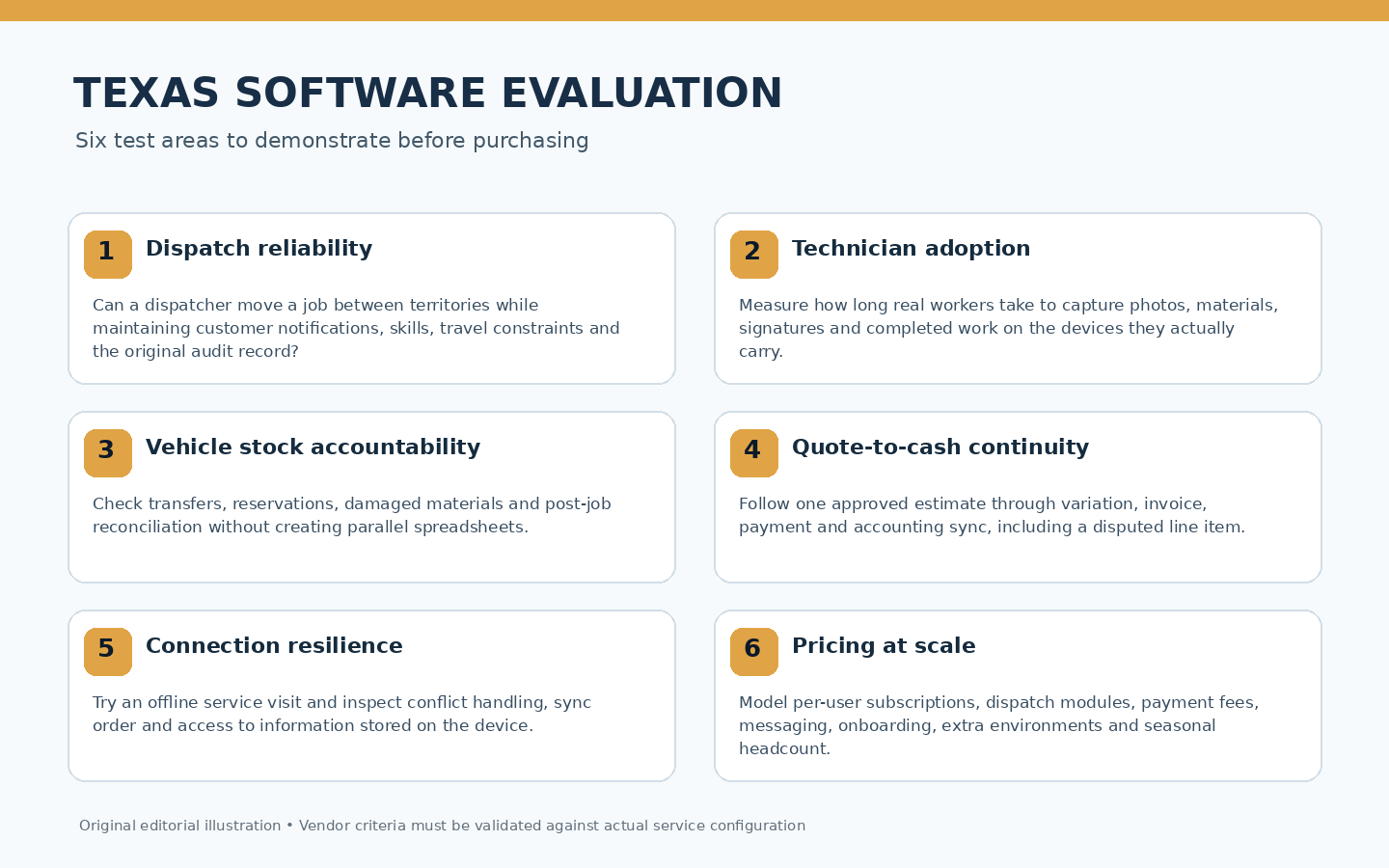
In Texas, evaluate Texas field service software with these six real-world trials and record vendor evidence.
1. Dispatch reliability
Can a dispatcher move a job between territories while maintaining customer notifications, skills, travel constraints and the original audit record? Set a documented Texas acceptance criterion for dispatch reliability; preserve the supporting demonstration and its reviewer’s outstanding questions.
2. Technician adoption
Measure how long real workers take to capture photos, materials, signatures and completed work on the devices they actually carry. Set a documented Texas acceptance criterion for technician adoption; preserve the supporting demonstration and its reviewer’s outstanding questions.
3. Vehicle stock accountability
Check transfers, reservations, damaged materials and post-job reconciliation without creating parallel spreadsheets. Set a documented Texas acceptance criterion for vehicle stock accountability; preserve the supporting demonstration and its reviewer’s outstanding questions.
4. Quote-to-cash continuity
Follow one approved estimate through variation, invoice, payment and accounting sync, including a disputed line item. Set a documented Texas acceptance criterion for quote-to-cash continuity; preserve the supporting demonstration and its reviewer’s outstanding questions.
5. Connection resilience
Try an offline service visit and inspect conflict handling, sync order and access to information stored on the device. Set a documented Texas acceptance criterion for connection resilience; preserve the supporting demonstration and its reviewer’s outstanding questions.
6. Pricing at scale
Model per-user subscriptions, dispatch modules, payment fees, messaging, onboarding, extra environments and seasonal headcount. Set a documented Texas acceptance criterion for pricing at scale; preserve the supporting demonstration and its reviewer’s outstanding questions.
A worked purchasing scenario
Imagine a regional HVAC company with eleven technicians and two dispatchers. On Monday it schedules a routine installation, receives an urgent service request and discovers that a replacement compressor is at a different warehouse. During a pilot, the dispatcher must see both capacity and stock, reroute a qualified employee and tell the first customer about a new ETA. The technician photographs the equipment without a cellular connection, adds a substitute part and collects an approved signature. Accounting receives the completed job once rather than reconstructing it from scattered texts. If each stage can be explained and repeated, the product is a better candidate than a vendor that promises ‘all-in-one’ without demonstrating the details.
How to organize the evaluation workshop
A decision workshop can be run with a wall-sized job board representing one ordinary Tuesday. Place tickets in three regions, set technician skill constraints, reserve vehicle parts and introduce a midday emergency. Require each shortlisted vendor to recreate the same changes while a dispatcher explains every manual intervention. Follow the emergency job into the invoice and compare its labor, travel and materials against the estimate. Include a customer who cannot be reached and a worker whose mobile device loses service. The operational committee should capture where data was entered twice and where a system made an assumption that only an experienced dispatcher could question. Ask the warehouse lead to reconcile stock the following morning rather than accepting a convenient on-screen balance. Include administration, finance and a frontline technician in the scoring group so the purchasing sponsor cannot dismiss practical friction. At the contract stage, confirm which features are available in the quoted tier and whether integrations, onboarding and seasonal user access incur separate charges.
Implementation, governance, and follow-up
The buying team should prepare a field-reality scorecard before negotiating price. Have a dispatcher define three job priorities and insist that the scheduling system display the consequences of accepting a late emergency call. Have the warehouse coordinator explain what counts as available stock versus reserved material. Give a technician a job containing installation instructions, customer photos and a requested signature; time how long it takes to complete without office assistance. Require the software to distinguish actual labor from estimated labor and to preserve a change-order approval. Ask finance to reconcile invoices when one payment is delayed and another is partially refunded. Examine manager override rights: an override should not silently erase a customer’s earlier appointment promise. Introduce a regional service boundary that changes seasonally and ask whether the map rules are understandable to ordinary administrators. Include notifications in the budget, because large numbers of text messages can meaningfully change economics. Document how the system handles vehicle stock after a technician leaves and returns a van. Finally, run a recovery exercise: export the next day’s schedule and the open work orders, then ask staff to interpret them outside the vendor’s interface. A successful field service platform should preserve clear decisions when schedules are disrupted, not only produce beautiful charts at the end of the month.
For the rollout, divide technicians into a pilot cohort and a later group that receives revised instructions. Give the initial cohort one-page workflows for arrival, materials capture, customer approval and failed connectivity. Track how many calls to dispatch the new system prevents and how many it creates. Hold a short reconciliation meeting after each field day so that lost notes, doubled parts and unusual invoices are corrected before they become accepted habits. Managers should investigate whether software notifications improve customers’ confidence or simply create messages nobody reads. For contracts, secure a detailed scope covering initial imports, mobile support, training for substitute dispatchers, data retrieval and the conditions under which additional branches change pricing. Evidence from actual work, not optimistic adoption targets, should decide expansion.
Questions buyers frequently ask
Should a Texas contractor buy CRM and field service software separately?
Sometimes. A specialist scheduling system can integrate with a CRM, but the integration needs a clear record owner, failure alerts and a dependable exchange of customer and job information.
What metric matters most during a pilot?
No single metric tells the story. Combine first-time fix rate, appointment reliability, technician adoption, parts accuracy and billing delay to see whether the workflow genuinely improved.
Do routing features replace an experienced dispatcher?
They support decisions but do not know every customer promise or emergency nuance. Evaluate override controls and audit history instead of expecting a fully automatic operation.
Further reading and source notes
Primary references for Texas Texas field service software. Obtain case-specific professional advice and independently verify service terms.