New York | New York retail POS accounting software
The purchase of a point-of-sale and accounting system looks simple until a New York retailer compares cash drawers, delivery channels, tax jurisdictions, returns and month-end reconciliation. A store in one borough may serve online customers elsewhere, while another sells exempt products alongside taxable merchandise. Software cannot replace a tax professional’s determination, but it can capture the evidence needed to support that determination. This guide explains what to demonstrate before committing to a POS, inventory and bookkeeping combination, with a special emphasis on audit-ready records rather than an attractive sales graph.
Define the transaction record in granular detail
New York’s tax guidance emphasizes dated sales records and enough transaction information to determine taxability and amounts collected. A prospective POS should preserve product, quantity, selling price, discounts, transaction date, payment method, invoice or receipt number and applicable tax information. Walk through a mixed basket rather than testing only a single straightforward purchase. Verify that voids, exchanges and partial refunds remain visible without erasing the original sale. When a cashier corrects a tender error, a manager should be able to reconstruct what happened. The audit trail is part of the product, not an optional reporting luxury.
Test locality mapping without guessing tax treatment
Different destinations, delivery terms and product classifications can affect a sale’s tax treatment. Choose a software workflow that supports well-governed tax rules and provides documented methods to update them. Run representative scenarios with a professional who understands the business: in-store pickup, a local delivery, a shipment outside the store’s locality and a return spanning reporting periods. Do not publish broad claims that a particular item is always taxable or exempt. The practical procurement question is whether staff can identify why the system calculated a specific result and correct a mapping without rewriting historical transactions.
Connect inventory to accounting rather than duplicating entries
A retail platform should distinguish physical count, sellable stock, reserved units, vendor returns and items lost to shrinkage. Test the handoff to accounting with cost of goods sold, supplier invoices and inventory adjustments that are supported by documentation. If the integration syncs only a daily revenue total, finance may still need manual journal entries to reconcile taxes, fees and refunds. Decide whether the POS or accounting ledger owns each concept, then verify how exceptions are surfaced. For multiple locations, ask whether a transfer creates a matching outflow and inflow rather than two unrelated corrections.
Treat online channels and payment settlement as a system
A business can have a successful sales day and an accounting discrepancy because card processors settle payments later and deduct fees. Build reconciliation around transaction date, settlement date, refunds, chargebacks, gift cards and platform commissions. Compare whether the POS can import marketplace transactions without double counting inventory or gross receipts. A useful test includes one online purchase, one canceled item and one split tender. Trace every event to a bank deposit and the general ledger. The goal is that finance can explain differences, not merely hide them in a suspense account.
Plan record retention and reliable exports
The New York Tax Department publishes retention and recordkeeping guidance, including specific requirements for sales-tax vendors. Evaluate the actual periods that apply to the company with qualified advisors. The technology test is whether records remain readable, attributable and exportable after changing software or closing a store. Request a historical transaction export, not just a sales summary PDF. Include exemptions, refunds, receipts and source identifiers. Keep a documented restoration method and verify backups with a sample recovery. Cloud access is convenient but does not eliminate the merchant’s responsibility to retain appropriate business records.
Design roles for cashiers, managers and bookkeepers
Cashiers may need to apply permitted discounts but should not silently rewrite tax configurations or erase sale histories. Regional managers require inventory visibility without full payroll access. Bookkeepers need reports and reconciliations but rarely need cardholder data. Compare granular role permissions, MFA, register session controls and the treatment of devices shared between shifts. Test a lost terminal and a dismissed employee to see how rapidly access can be revoked. Vendor support access should be time bounded and recorded. These operational controls are easier to demonstrate before a contract than after an incident.
Pilot with the hardest month-end, not the best sales day
Have the trial reproduce an actual accounting period using fictional data: purchasing, a mixed-tax sale, a customer exchange, processor fees, vendor credit, shrinkage and an inventory transfer. Reconcile receipts and deposits as finance ordinarily does. Measure time spent finding discrepancies and compare exported transaction records with the summary ledger. A POS demonstration can make checkout feel effortless while leaving accountants to repair opaque integrations every weekend. Require the vendor to show that it understands the store’s real exceptions and provides a recoverable data model.
A practical buyer’s evidence checklist
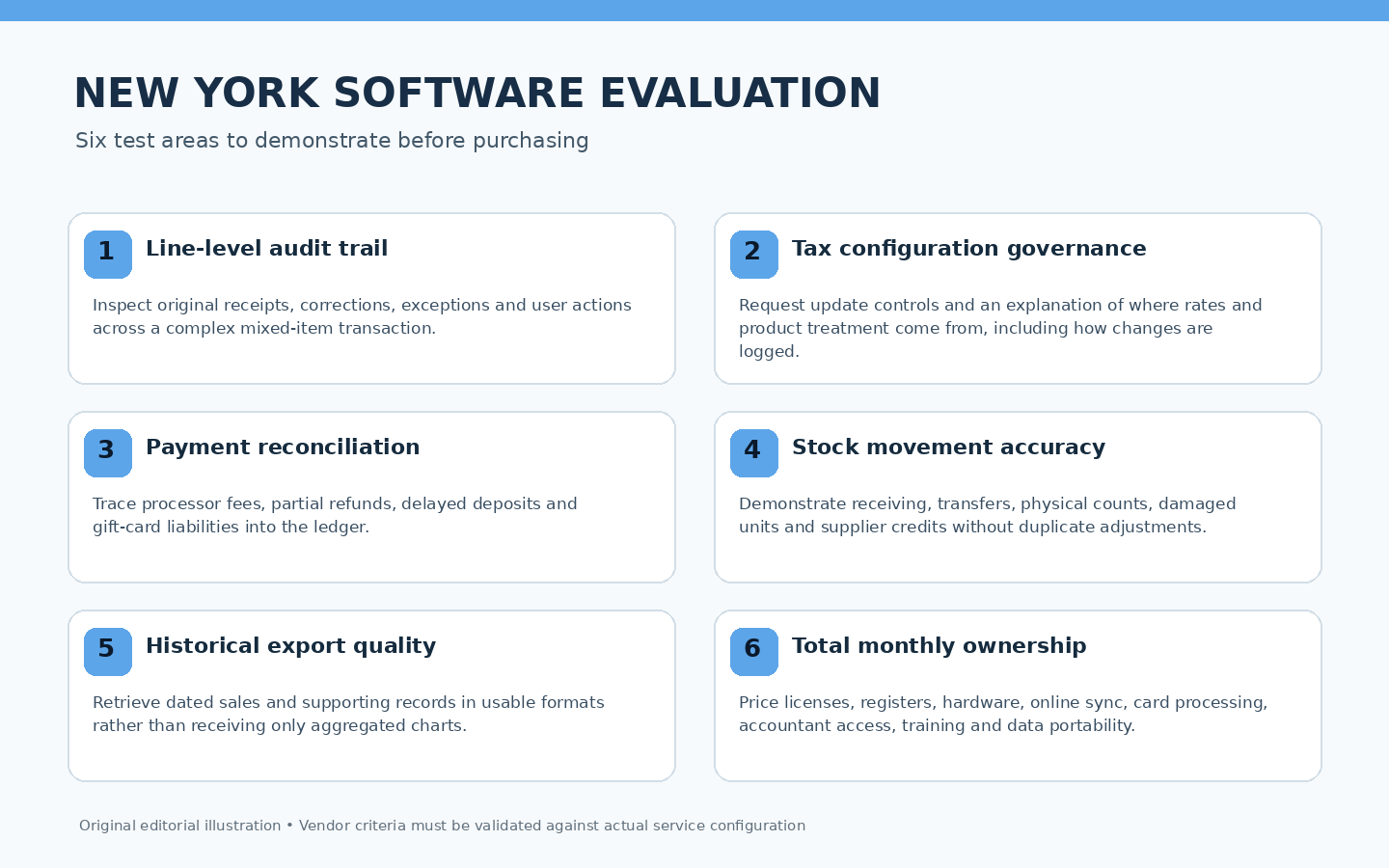
In New York, evaluate New York retail POS accounting software with these six real-world trials and record vendor evidence.
1. Line-level audit trail
Inspect original receipts, corrections, exceptions and user actions across a complex mixed-item transaction. Set a documented New York acceptance criterion for line-level audit trail; preserve the supporting demonstration and its reviewer’s outstanding questions.
2. Tax configuration governance
Request update controls and an explanation of where rates and product treatment come from, including how changes are logged. Set a documented New York acceptance criterion for tax configuration governance; preserve the supporting demonstration and its reviewer’s outstanding questions.
3. Payment reconciliation
Trace processor fees, partial refunds, delayed deposits and gift-card liabilities into the ledger. Set a documented New York acceptance criterion for payment reconciliation; preserve the supporting demonstration and its reviewer’s outstanding questions.
4. Stock movement accuracy
Demonstrate receiving, transfers, physical counts, damaged units and supplier credits without duplicate adjustments. Set a documented New York acceptance criterion for stock movement accuracy; preserve the supporting demonstration and its reviewer’s outstanding questions.
5. Historical export quality
Retrieve dated sales and supporting records in usable formats rather than receiving only aggregated charts. Set a documented New York acceptance criterion for historical export quality; preserve the supporting demonstration and its reviewer’s outstanding questions.
6. Total monthly ownership
Price licenses, registers, hardware, online sync, card processing, accountant access, training and data portability. Set a documented New York acceptance criterion for total monthly ownership; preserve the supporting demonstration and its reviewer’s outstanding questions.
A worked purchasing scenario
A hypothetical apparel store sells a jacket and a taxable accessory, accepts a partial gift-card payment and later processes a return at a second branch. Its POS evaluation uses this sequence to test line-level tax documentation, settlement and inventory movement. A cashier should not be able to delete the original transaction simply to make the drawer balance. The finance team compares the refund, tax correction, merchant statement and store-level stock. When the candidate solution makes each link visible, it supports both day-to-day operations and future questions about business records. A low-priced subscription without traceable records would be the wrong bargain.
How to organize the evaluation workshop
A useful workshop recreates a complete fictional business week with opening inventory, a vendor delivery, online orders, counter sales, refunds and closing cash. Give the bookkeeping participant permission to challenge the POS numbers and require the product specialist to locate the source transaction for each disputed total. Ask a tax advisor to supply test categories rather than asking a salesperson to offer legal conclusions about local sales-tax treatment. Follow a refund issued after the reporting period closes and document how the accounting export represents the correction. For an organization with more than one store, create a transfer that starts with one inventory count and ends with the same item recorded at the destination. After the exercise, export dated sales and the associated receipt detail and verify that they remain intelligible outside the original dashboard. Include the cost of accountant access, card-processing settlement tools, hardware replacement and register training in the buying recommendation. An elegant checkout that cannot explain the balance sheet does not meet the assignment.
Implementation, governance, and follow-up
For a purchase decision, create a structured month-end examination rather than trusting a short retail demonstration. The first test should trace an item’s receipt from the supplier through stocking and sale. The second should explore a mixed basket with discounts and a tax configuration approved by the business’s qualified advisor. The third should involve a partial refund after card settlement. The fourth should test a transfer between locations, including which employee approved it and how quantities reconcile. The fifth should export original and corrected transactions separately, so a reviewer can see the actual history. Next, ask how the system behaves when internet connectivity fails at the register and how pending events are reconciled on reconnection. Make sure a cashier cannot reach configuration functions that control companywide accounting simply by switching interface tabs. Decide who maintains the product tax classifications and what change-control steps apply before a new category goes live. Bring the outside bookkeeper into the evaluation and ask for a real journal export from a synthetic sales week. Include receipt storage, backup restoration, return policies and the cost of more registers in the subscription model. If the provider cannot demonstrate line-level evidence outside its own reporting interface, the retailer needs a stronger record-retention strategy before switching systems.
A small retail business can also gain value by writing a concise data dictionary for every integration. A chargeback reference, payment settlement identifier, register number and original receipt number should have stable meanings across systems. Finance should identify which reports are relied upon during monthly closing and whether they can be reproduced after a vendor update. Avoid granting an outside implementation contractor permanent administrator privileges simply for convenience. Audit any automated product tax changes before they go live. When a store begins marketplace selling, document who owns returns and stock adjustments to prevent duplicate accounting entries. This discipline improves both the purchasing decision and the eventual training material for managers.
Questions buyers frequently ask
Can a POS system guarantee New York sales-tax compliance?
No. It can implement configured rules and preserve evidence, but the business and its advisors must determine applicable treatment and monitor changes.
Why is a daily sales summary insufficient?
A summary cannot by itself explain each return, exemption, tender adjustment or tax calculation. Detailed, retained transaction records matter.
What should be exported before changing providers?
Request item-level sales, taxes, inventory movements, payment references, customer permissions and audit histories in formats your replacement tools can use.
Further reading and source notes
Primary references for New York New York retail POS accounting software. Obtain case-specific professional advice and independently verify service terms.