






A CRM can increase sales, improve follow-up, and give you a clearer picture of your pipeline. It can also become an expensive database that nobody trusts.
The difference is rarely the brand you choose. It is how the system is set up, used, and maintained. In 2026, these problems are more costly than before because AI features, reporting, and automation all depend on clean processes and reliable data.
Here are the nine mistakes that most often undermine CRM results — and the practical fixes that actually work.
1. Buying the CRM Before Defining the Process
Many teams start with software and hope the process will appear later. It does not.
If you do not know how leads should be handled, how deals should move, or what “good follow-up” looks like, the CRM just becomes a more complicated version of the chaos you already had.
Fix: Write the process first. Keep it simple. For sales, define stages, required next steps, and who owns each record. For service, define how tickets are created, assigned, and closed. Then configure the CRM to match that process.
2. Importing Years of Dirty Data on Day One
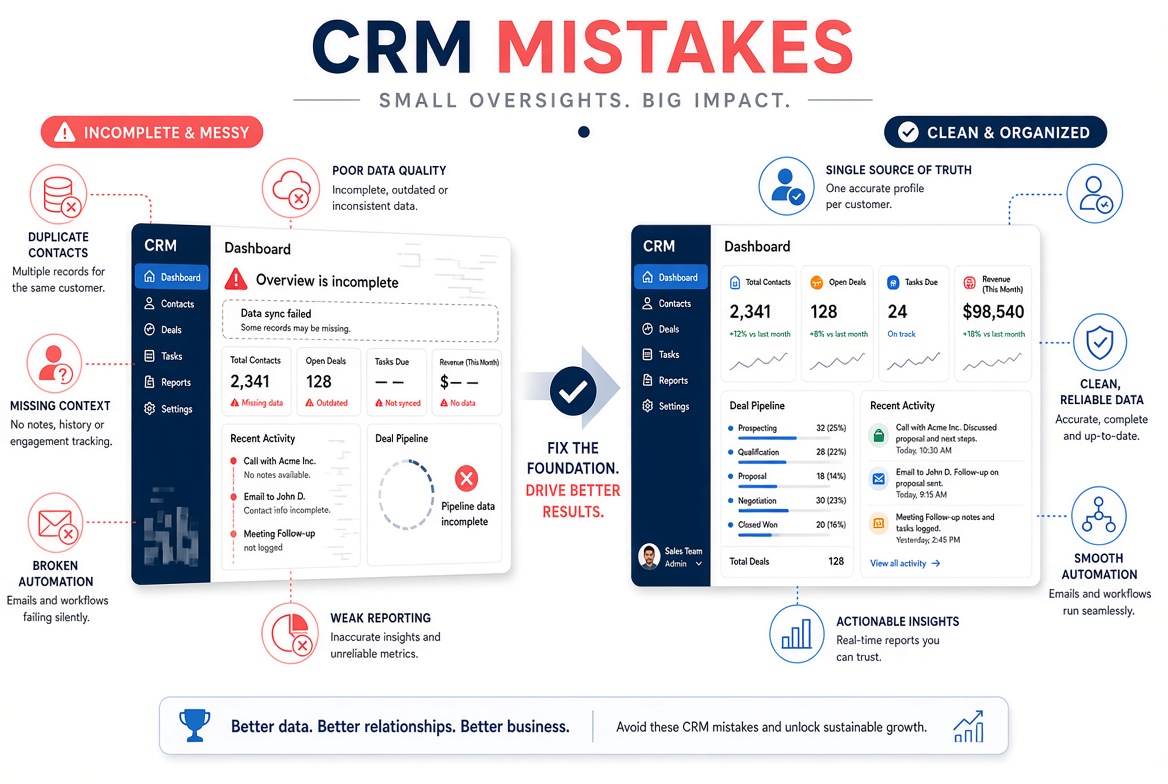
Old spreadsheets, duplicate contacts, missing emails, and outdated companies make the system hard to trust from the start. Once people stop trusting the data, they stop using the CRM.
Fix: Import only what you need to operate now: active customers, open deals, and current leads. Clean those records first. Archive or leave behind the rest. You can always add historical data later if it is actually useful.
3. Making People Fill Out Too Many Fields
Required fields feel like control. In practice, they create resistance. Reps skip records, enter junk, or work outside the system.
Fix: Require only the fields that change a decision or a next action. Everything else should be optional. If a field is not used in a report, workflow, or handoff, it probably should not be mandatory.
4. Treating the CRM as an Admin Tool Instead of a Daily Work Tool
If the only reason to open the CRM is “management wants it updated,” adoption will collapse. People use tools that help them close deals, remember follow-ups, and look prepared in conversations.
Fix: Make the CRM useful in the moment. Show the next task, the last conversation, the open deal, and the customer history without extra clicks. Review the pipeline in the CRM, not in a side spreadsheet.
5. No Clear Ownership of Records
When everyone can edit everything and no one is accountable, records go stale. Deals stall. Follow-ups disappear. Customers get contacted twice — or not at all.
Fix: Every lead, contact, and opportunity should have an owner. Set a simple rule for what happens when someone leaves, when a deal goes cold, and when a lead needs to be reassigned. Ownership is more important than perfect permissions.
6. Ignoring Pipeline Hygiene
A pipeline full of dead deals, missing close dates, and “next steps” from three months ago is worse than no pipeline. It creates false forecasts and hides real problems.
Fix: Run a short weekly pipeline review. Ask three questions for every active deal: Is this still real? What is the next step? When will it happen? Close or recycle anything that is not moving. Hygiene is a habit, not a cleanup project.
7. Automating Too Early
Automation on top of a broken process just creates faster mistakes: wrong emails, duplicate tasks, bad lead routing, and frustrated customers.
Fix: Get the manual process working first. Then automate the repetitive parts that already happen the same way every time. Start with one or two high-value workflows, measure them, and expand only after they are reliable.
8. Never Measuring Whether the CRM Is Working
“We implemented a CRM” is not a result. If you do not track usage and business outcomes, you cannot tell whether the system is helping or just adding overhead.
Fix: Track a small set of numbers:
- Are people actually logging activity?
- Are key fields complete?
- Is the pipeline current?
- Did follow-up speed improve?
- Did win rate, cycle time, or retention change?
Review these monthly. If the numbers are weak, fix the process and adoption before buying more features.
9. Turning On AI Without Guardrails
In 2026, almost every serious CRM includes AI: suggested emails, lead scoring, summaries, and even agents that take action. Used well, this saves time. Used poorly, it sends the wrong message, acts on bad data, or creates work nobody reviews.
Fix: Start with low-risk assistance: summaries, drafts, and reminders. Keep humans in the loop for customer-facing actions until the results are consistently good. Monitor what the AI is doing. Bad data plus autonomous action is an expensive combination.
A Simple Standard That Prevents Most of These Problems
You do not need a perfect CRM. You need a usable one.
Use this minimum standard:
- Every active customer and deal lives in the CRM
- Every record has an owner
- Every open deal has a next step and a date
- The pipeline is reviewed every week
- Only essential fields are required
- Data is cleaned before it is trusted
- Automation and AI are added after the basics work
Teams that follow this standard get value even from a simple platform. Teams that skip it struggle even with the most expensive one.
Final Takeaway
CRM failure is usually quiet. The licenses stay active. The dashboards still exist. But the real work happens in email, chat, and memory. That is when revenue leaks: missed follow-ups, stale forecasts, duplicated outreach, and customers who feel like nobody remembers them.
Fix the process, the data, and the daily habits first. Then the software can do its job.
A CRM does not create discipline. It rewards it. In 2026, the companies getting the best return are not the ones with the most features. They are the ones that use a clean, simple system consistently.