Colorado | Colorado marketing automation privacy software
Marketing automation earns its place when it helps a business communicate with people who actually want the interaction. For Colorado teams, that purchase also raises practical questions about consumer preferences, targeted advertising, consent and the journey of data among a website, CRM, analytics service and campaign platform. Colorado’s Privacy Act provides rights and obligations for covered controllers, and the state recognizes Global Privacy Control as a universal opt-out mechanism in relevant circumstances. An automation platform should fit a coherent business process rather than become an excuse to accumulate more personal data.
Map the purpose of each marketing data field
Start with the forms, chat widgets, event registrations and purchase histories that feed your automations. Distinguish information needed to deliver a service from information collected only for audience enrichment or experimentation. For a Denver-based subscription business, ask whether a webinar sign-up should automatically create an advertising audience member. Give each major data flow an owner, retention plan and documented purpose. The resulting map is a better procurement artifact than a feature list boasting thousands of integrations. It lets stakeholders inspect what should happen when a contact changes a preference or exercises a recognized right.
Understand the universal opt-out workflow
The Colorado Attorney General explains that businesses within the CPA’s scope must recognize qualifying universal opt-out mechanisms, with Global Privacy Control identified in the state’s published guidance. A website signal needs to reach the systems that execute the relevant use of personal data. Test a browser visit using GPC, follow the resulting event through consent management, customer profiles and advertising connectors, and check whether subsequent audience updates reflect the choice. Avoid assuming that an ordinary unsubscribe link solves every targeted-advertising question. Determine with counsel which flows and entities fall within the statute and how the technical handling should be documented.
Design lifecycle journeys that can stop gracefully
A welcome sequence, trial-conversion campaign and customer renewal workflow should have clear entry and exit conditions. Show how the system treats a newly unsubscribed contact, a person who changes their email address and an account that moves from prospect to paying customer. Duplicate profiles can cause multiple messages even when the dashboard reports a single conversion. Require a suppression architecture that is reliably shared between campaign tools and CRM segments. Test resumption after a temporary integration outage so that a backlog does not unexpectedly send several weeks of communications to people who are no longer eligible.
Evaluate attribution without pretending to prove causality
Modern marketing suites promise multi-touch attribution, but channel metrics depend on identity matching, cookie availability, conversion windows and data quality. A useful buyer compares aggregate campaign cost, qualified opportunities, actual conversions and customer retention while documenting what each platform can observe. Resist a vendor demonstration that equates an attributed conversion with revenue caused by one advertisement. Ask for exportable event definitions and a way to reconcile leads against sales records. Include a plan for reporting when users decline optional tracking, because measurement should remain meaningful without pressuring people to surrender choices.
Check contract roles and downstream processors
Campaign software commonly connects to email delivery, SMS, analytics, advertising and personalization vendors. Make an inventory of which organization determines processing purposes and which providers perform services under instructions. Request data-processing terms, subprocessor information, export formats, permission controls and deletion procedures. Ask whether sensitive classifications or inferred scores can be turned off. Contracts must be reviewed with a qualified professional rather than assuming an international certification supplies local compliance. The operational objective is the ability to understand and govern each connector without giving every marketer unrestricted administrative power.
Build a revenue case around fewer wasted touches
A business case should count marketing hours, deliverability, conversion quality, retained customers and subscription or message costs. Automation sometimes increases campaign volume while harming customer experience; that is not necessarily a productivity gain. Establish a baseline for response time, rework caused by duplicate leads and manual list reconciliation. During a pilot, measure the difference between sending more messages and sending appropriately timed messages to qualifying audiences. Budget for implementation, preference-center design, data cleansing, integrations and future reviews. An inexpensive license without dependable suppression can generate more risk than savings.
Test with synthetic journeys and preference reversals
Create a fictitious prospect who browses an article, requests a demo, declines targeted advertising and later becomes a customer. Observe what appears in the CRM, reporting, email platform and optional ad connector at each stage. Introduce a broken webhook and then restore it; check whether the integration floods an audience with stale events. Let a marketer draft content but restrict publication rights, and inspect the approval trail. A credible automation platform should make its decision rules inspectable so that the team can explain why a person did or did not receive a message.
A practical buyer’s evidence checklist
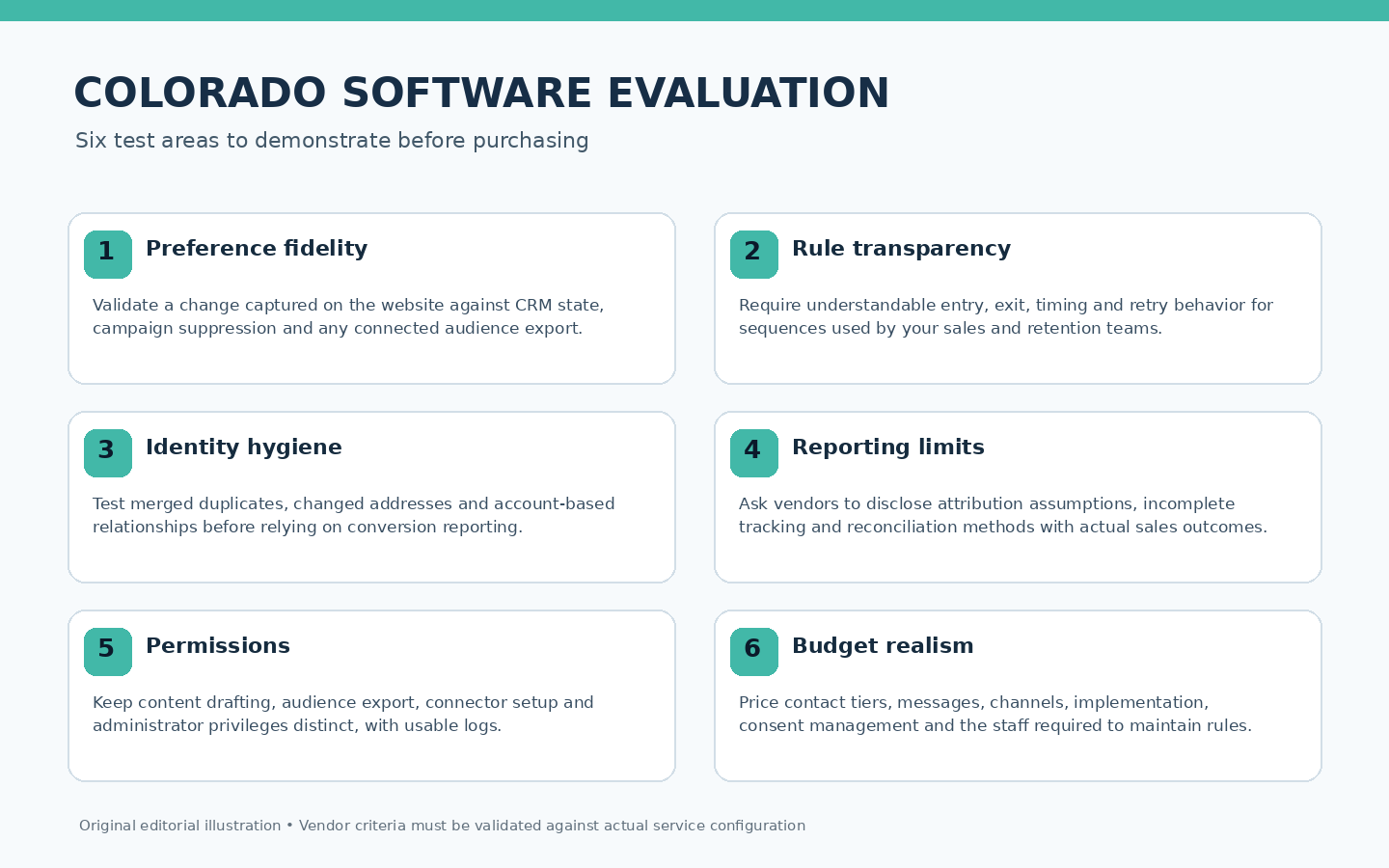
In Colorado, evaluate Colorado marketing automation privacy software with these six real-world trials and record vendor evidence.
1. Preference fidelity
Validate a change captured on the website against CRM state, campaign suppression and any connected audience export. Set a documented Colorado acceptance criterion for preference fidelity; preserve the supporting demonstration and its reviewer’s outstanding questions.
2. Rule transparency
Require understandable entry, exit, timing and retry behavior for sequences used by your sales and retention teams. Set a documented Colorado acceptance criterion for rule transparency; preserve the supporting demonstration and its reviewer’s outstanding questions.
3. Identity hygiene
Test merged duplicates, changed addresses and account-based relationships before relying on conversion reporting. Set a documented Colorado acceptance criterion for identity hygiene; preserve the supporting demonstration and its reviewer’s outstanding questions.
4. Reporting limits
Ask vendors to disclose attribution assumptions, incomplete tracking and reconciliation methods with actual sales outcomes. Set a documented Colorado acceptance criterion for reporting limits; preserve the supporting demonstration and its reviewer’s outstanding questions.
5. Permissions
Keep content drafting, audience export, connector setup and administrator privileges distinct, with usable logs. Set a documented Colorado acceptance criterion for permissions; preserve the supporting demonstration and its reviewer’s outstanding questions.
6. Budget realism
Price contact tiers, messages, channels, implementation, consent management and the staff required to maintain rules. Set a documented Colorado acceptance criterion for budget realism; preserve the supporting demonstration and its reviewer’s outstanding questions.
A worked purchasing scenario
A hypothetical Colorado training company runs a free workshop followed by a three-message sequence. A participant declines certain data uses through a qualifying website signal, while another subscriber updates a mailing preference in an email footer. During testing, marketing imports new event attendees and discovers that the old advertising connector still has stale segments. The team fixes the propagation rule before launch, then tracks workshop attendance and paid enrollments using clearly defined events. The new software earns approval for preventing improper outreach and clarifying the customer journey, not simply for drawing attractive funnels on an executive slide.
How to organize the evaluation workshop
Use a whiteboard to construct four fake customer journeys: an unconsented visitor, an opted-in newsletter reader, a returning buyer and a person whose privacy preference changes midway through a campaign. Mark which teams are allowed to send operational communications and which campaigns rely on optional marketing or advertising processing. During the trial, turn on a supported browser opt-out signal, inspect actual connector behavior and record any differences between visible preferences and downstream events. Move one fictitious lead between sales stages to ensure sequence exits are not delayed. Have an analyst reconcile the marketing dashboard with accepted opportunities rather than interpreting every click as an attributed sale. Finally, break an integration for an hour and examine retry behavior after reconnection. The procurement decision should capture ambiguous fields, failures needing manual monitoring and any misleading attribution assumptions. Invest time in those details before scaling campaigns, because a modestly priced automation platform can magnify a poorly defined data process very quickly.
Implementation, governance, and follow-up
Make a decision log for marketing automation that records the reason behind each active data exchange. For a web form, note the promised purpose, destination, retention approach and entry conditions for any resulting campaign. For a conversion event, specify whether the system observed the event directly or imported it from another platform. Build an approval gate before marketers activate a new pixel, audience connector or personalization provider. During trial testing, compare the behavior of a contact who explicitly subscribes with someone who has only requested a product brochure. Observe whether a preference update removes the second person from irrelevant sequences, and test what happens when consent records arrive out of order. Ask the salesperson to show failed automation jobs rather than only successful sends; the quality of exception reporting determines how much human supervision is needed. Have an analyst calculate the cost of duplicate leads and unnecessary messages using internal estimates, not a vendor’s aspirational return-on-investment calculator. Keep documentation of applicable privacy obligations and technical implementation in the same project repository. This gives the firm a basis for future audits and prevents rapid campaign growth from quietly expanding the data it shares.
The first monthly governance meeting should review three things: newly activated connectors, contacts with unresolved preference conflicts and automation jobs that failed to complete. Keep an owner for each item. It can be useful to document what campaign analytics cannot know because of tracking limitations, so leadership does not overinterpret precise-looking charts. Require a second person to approve changes that broaden an audience or create a new destination for personal information. Review whether account managers can explain the distinction between a necessary service message and promotional outreach. The goal of automation is not to eliminate human judgment but to encode responsible choices consistently at operating scale.
Questions buyers frequently ask
Does GPC mean a website must stop all data collection?
No. Its effect depends on the applicable rules and purposes, especially recognized opt-outs for sale or targeted advertising; evaluate the actual workflow and legal scope.
Can marketing automation replace a consent-management platform?
Not necessarily. Some automation suites store preferences but cannot handle the full site-level collection and signal-routing requirements without an additional solution.
Which pilot exposes the most hidden problems?
A sequence with duplicate profiles, an opt-out, a conversion and a failed integration reveals more than sending one successful welcome email.
Further reading and source notes
Primary references for Colorado Colorado marketing automation privacy software. Obtain case-specific professional advice and independently verify service terms.