Oregon | Oregon ecommerce privacy software
An Oregon merchant choosing an online storefront also chooses the technology that stores customer identities, connects payments, updates inventory and shares signals with email or advertising vendors. The Oregon Consumer Privacy Act sets obligations for covered organizations, and the Department of Justice has published business FAQs along with guidance about recognized opt-out signals. The law’s scope and exemptions are important; a store should assess its own situation rather than infer that every e-commerce transaction creates the same obligation. This guide connects the software purchase to accurate operations and transparent customer-data handling.
Document the order and customer-data flow
Draw the path from product browse to cart, payment, fulfillment, returns, email and support. Include third-party checkout, fraud services, tax tools and advertising pixels that may be easy to overlook when a theme installs them automatically. Identify which application owns order status and which systems store personal identifiers. A merchant may discover that a cancelled purchase remains in an old marketing audience while an updated address does not reach a fulfillment partner. Write the data map before selecting new apps; it serves as a deployment plan, a privacy review aid and a checklist for removing forgotten integrations.
Translate Oregon privacy rights into store procedures
The Oregon Department of Justice explains the law’s business applicability and consumer rights, including opt-out mechanisms relevant to covered processing. As of January 2026, covered businesses have obligations concerning qualifying opt-out signals under the law. Work with qualified advisors to determine exactly which activities and entities are in scope. Technically, the store needs reliable ways to recognize a request, authenticate appropriately, find relevant customer records, document actions and communicate with processors. Test whether a browser privacy signal reaches each applicable advertising tool; do not confuse a newsletter unsubscribe with an all-purpose privacy response.
Keep inventory, returns and delivery promises coherent
A profitable store cannot focus only on checkout conversion. Compare how platforms reserve inventory, handle backorders, synchronize marketplace sales and issue partial refunds. Test an order containing two items, one of which is returned after the other has shipped. Make sure the customer-service screen, warehouse picking queue and accounting integration agree about what is owed. Avoid a feature stack in which multiple apps independently edit product quantities with no conflict resolution. A simpler workflow that prevents overselling can produce more customer trust than an elaborate upsell engine that introduces inconsistent records.
Review payment and fraud tools without over-collecting data
Payment processors and fraud services need appropriate information, but a merchant should not retain sensitive card data unnecessarily. Determine which provider handles payment information, how disputes and refunds are linked to the original transaction and which risk scores are stored in the storefront. Compare staff permissions for payment actions and establish separate approvals for high-value refunds. Ask how the provider shares incident information and how merchant staff revoke access if an account is compromised. A conversion optimization decision should not quietly expand the business’s data collection far beyond what it can understand or protect.
Test marketing integrations with real preference scenarios
Install only the essential analytics and campaign tools during a trial. Create fictional visitors with differing privacy choices, then trace whether optional advertising events are sent as expected. Review how the store handles a customer who changes an email address, deletes an account or returns months later on another device. A reporting dashboard can be useful without claiming precise knowledge of every person behind an anonymous session. Keep privacy notice language aligned with actual integrations and establish who approves any newly proposed tracking application before it reaches the live site.
Demand portable product, order and content exports
Vendors often make initial setup easy and migration out difficult. Ask how to export products, variants, pricing, media, customers, orders, tax documentation and content relationships with stable identifiers. Check whether subscription plans, gift-card balances and return histories travel in usable form. Do not assume a CSV of customer names is a full exit strategy. Plan redirects and testing if domain or permalink structures change, and preserve relevant business records for appropriate periods. Ownership of the storefront domain, payment account and integrations should remain explicit in contracts and administrator inventories.
Model the economics of an integrated store
A low monthly plan can hide payment charges, transaction fees, premium applications, return handling, support costs and hours spent reconciling channels. Build a sample month with orders, refunds, subscription renewals and a seasonal traffic peak. Calculate gross profit after fulfillment and acquisition costs rather than treating revenue as software ROI. Evaluate staff time to resolve exceptions and ask whether removing redundant apps would simplify both cost and privacy oversight. The strongest platform decision balances customer experience, operational reliability and the ability to understand where store data goes.
A practical buyer’s evidence checklist
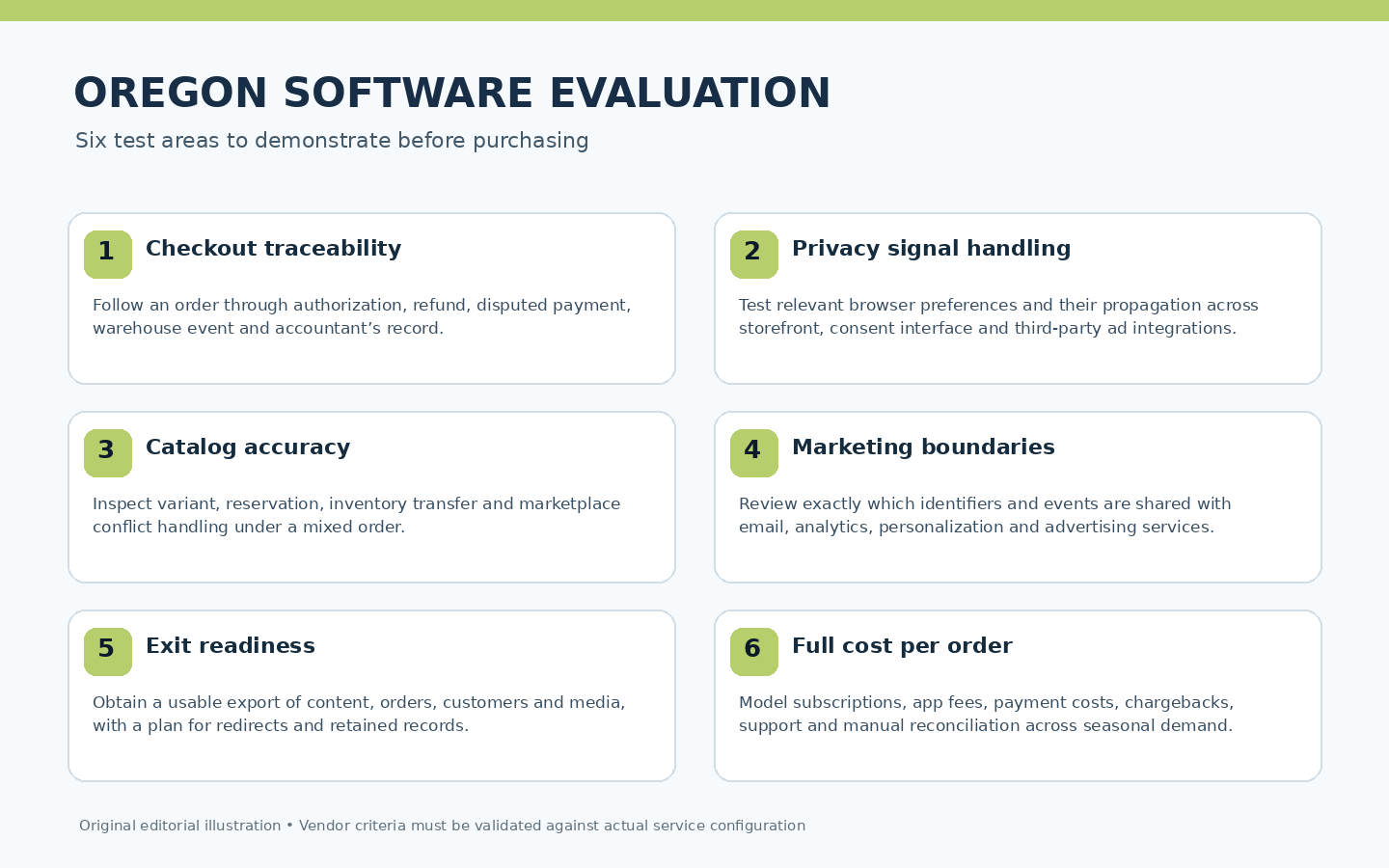
In Oregon, evaluate Oregon ecommerce privacy software with these six real-world trials and record vendor evidence.
1. Checkout traceability
Follow an order through authorization, refund, disputed payment, warehouse event and accountant’s record. Set a documented Oregon acceptance criterion for checkout traceability; preserve the supporting demonstration and its reviewer’s outstanding questions.
2. Privacy signal handling
Test relevant browser preferences and their propagation across storefront, consent interface and third-party ad integrations. Set a documented Oregon acceptance criterion for privacy signal handling; preserve the supporting demonstration and its reviewer’s outstanding questions.
3. Catalog accuracy
Inspect variant, reservation, inventory transfer and marketplace conflict handling under a mixed order. Set a documented Oregon acceptance criterion for catalog accuracy; preserve the supporting demonstration and its reviewer’s outstanding questions.
4. Marketing boundaries
Review exactly which identifiers and events are shared with email, analytics, personalization and advertising services. Set a documented Oregon acceptance criterion for marketing boundaries; preserve the supporting demonstration and its reviewer’s outstanding questions.
5. Exit readiness
Obtain a usable export of content, orders, customers and media, with a plan for redirects and retained records. Set a documented Oregon acceptance criterion for exit readiness; preserve the supporting demonstration and its reviewer’s outstanding questions.
6. Full cost per order
Model subscriptions, app fees, payment costs, chargebacks, support and manual reconciliation across seasonal demand. Set a documented Oregon acceptance criterion for full cost per order; preserve the supporting demonstration and its reviewer’s outstanding questions.
A worked purchasing scenario
An Oregon outdoor-products retailer replaces a storefront that has accumulated twelve plugins. Its pilot processes a two-item order, a split shipment and a delayed return while a fictitious browser sends a recognized privacy preference. The review team learns that an old campaign script still transmits an event despite the new store’s settings, so it removes the redundant integration before launch. Inventory and accounting teams then verify that refunds and stock availability reconcile to the same order. A platform that reduces duplicate apps while preserving customer choices offers a more durable outcome than one that wins purely on theme design.
How to organize the evaluation workshop
Create a simulated seasonal promotion with a flash-sale order, an out-of-stock variant, a partial refund and a customer who changes a data preference. Ask the store team to inspect stock counts and tax-related transaction records after each event. Disable one unnecessary plugin and see whether the checkout still works without sharing duplicate data with an advertising endpoint. Build a fictitious request to retrieve customer information and follow it through the fulfillment provider and email service where relevant. A separate employee should export products, orders and images into a blank environment to establish whether switching vendors would be practical. During the budget discussion, calculate costs from an actual basket of services, including processing, app subscriptions, fraud controls, returns and labor spent on exception handling. A sensible platform purchase keeps the store’s most important records understandable while allowing the merchant to govern how customer information moves across the wider commerce stack.
Implementation, governance, and follow-up
The merchant should start software procurement with a sample order history and a map of customer-facing promises. Show what the store commits to at checkout about delivery, refund eligibility, customer communication and optional marketing. Test a split shipment that produces two fulfillment events but only one original order, then return one item and examine accounting and inventory results. Ask the payment provider to clarify which sensitive payment information the store itself does not need to hold. For privacy operations, create a test preference signal and review every eligible connected tool that should respect it under the organization’s assessed obligations. Maintain an approved list of plugins and require a short data-flow review before installing another promotional widget. Ask for a vendor-independent product catalog export, including images and variant IDs, so the business has a viable migration plan. Calculate total cost using real transaction assumptions, not an unlimited-growth slide supplied by the platform. A good e-commerce stack should protect the integrity of orders while allowing the merchant to explain its use of customer information in plain language.
Before launch, assign separate owners for product data, customer-service responses, payment reconciliation and marketing integrations. Each owner should sign off on the sample transaction tests and document exceptions. Configure a process for reviewing new storefront plugins and removing obsolete ones so that the original data map stays accurate. Consider how an account closure interacts with genuine record-retention needs instead of promising deletion of every transaction regardless of context. Periodically retest browser privacy signals and the downstream behavior of enabled advertising tools. Operating a store responsibly requires a maintainable system, not merely a fast checkout page.
Questions buyers frequently ask
Does the Oregon privacy law cover every web store?
No. The law has application thresholds and exemptions; evaluate your business, data volume and processing details using official resources and appropriate advice.
Will one privacy plugin fix every connected app?
Not automatically. Consent and opt-out signals must be routed appropriately to actual downstream technologies, then tested.
Which exports matter most before switching stores?
Products, variants, inventory, original orders, returns, customer records, media, content and any balances or contracts needed for continuity.
Further reading and source notes
Primary references for Oregon Oregon ecommerce privacy software. Obtain case-specific professional advice and independently verify service terms.