





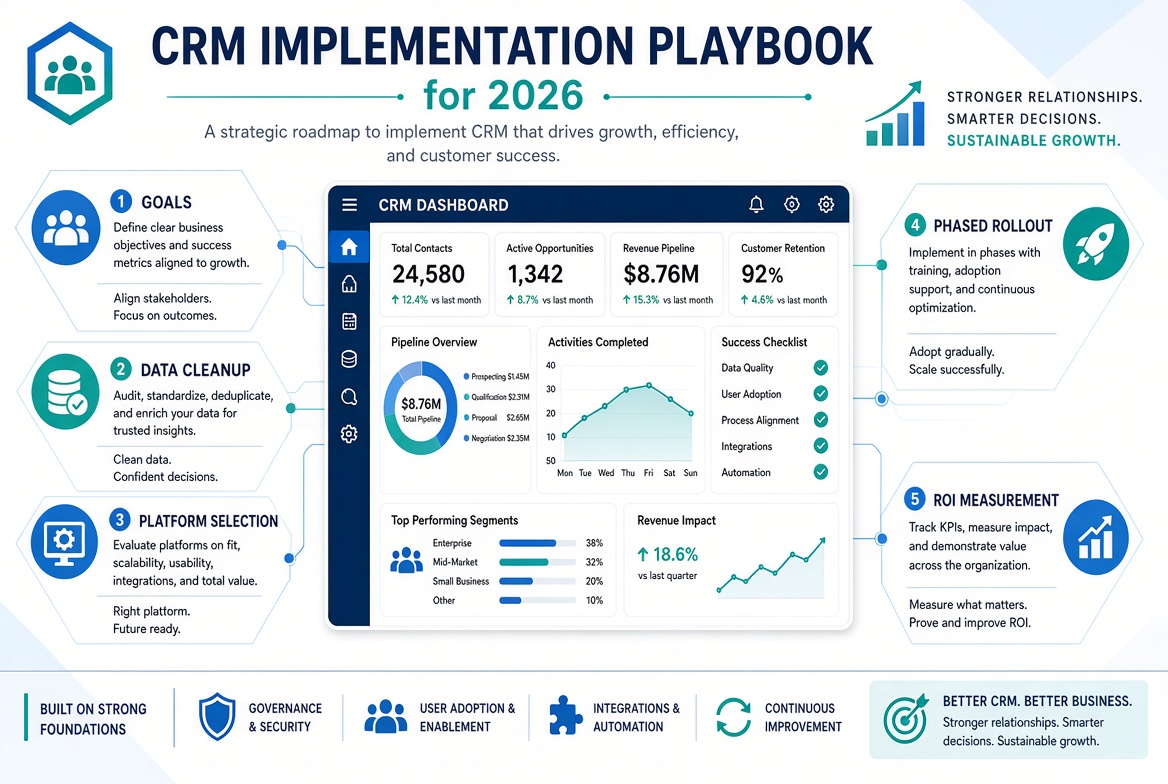
Most companies buy a CRM. Far fewer get real results from it.
The difference is rarely the software. It is how the project is planned, launched, and managed after go-live. In 2026, with AI agents, higher data volumes, and rising customer expectations, a poorly executed CRM costs more than it ever did — in wasted licenses, lost deals, and frustrated teams.
This playbook gives you a practical, step-by-step approach to choosing the right system, implementing it without chaos, driving adoption, and measuring ROI. It is written for business owners, revenue leaders, and operations managers who want outcomes, not just another tool.
Why So Many CRM Projects Fall Short
The typical failure pattern looks like this:
- The company buys a well-known platform
- Data is migrated without cleaning
- Processes stay the same as before
- Training is generic and one-time
- Adoption drops after the first month
- Leadership wonders why the investment is not paying off
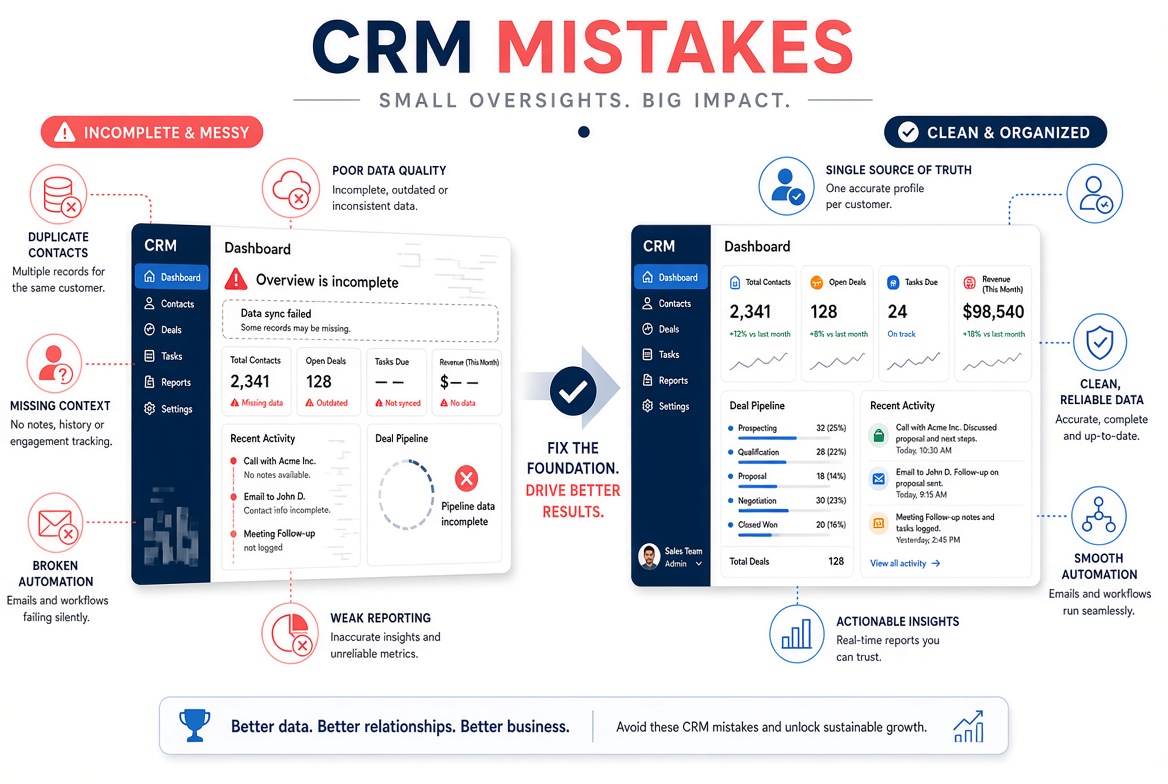
Common root causes include unclear goals, dirty data, lack of process change, and treating CRM as an IT project instead of a business change.
The good news: these problems are preventable when you follow a structured approach.
Step 1: Define Clear Goals and Success Metrics
Do not start with features. Start with outcomes.
Ask:
- What specific problems are we trying to solve?
- How will we know the CRM is working in 90 days? In 12 months?
Strong examples of measurable goals:
- Increase sales productivity by reducing time spent on data entry
- Improve forecast accuracy
- Shorten average sales cycle
- Raise first-response time in support
- Increase lead-to-opportunity conversion
- Reduce customer churn in a specific segment
Write these down and agree on them with leadership before you evaluate any software. Everything else — vendor selection, configuration, training — should serve these goals.
Step 2: Map Current Processes and Audit Your Data
A CRM will amplify whatever you already have — good or bad.
Document how work actually happens today:
- How do leads enter the business?
- How are opportunities updated?
- How is customer history shared between sales, marketing, and support?
- Where do things get stuck or lost?
Then audit the data. Typical issues include duplicates, incomplete records, outdated contacts, inconsistent fields, and information trapped in spreadsheets or inboxes.
In 2026 this step is even more important because AI agents perform poorly on messy data. Cleaning before go-live is cheaper than trying to fix it later.
Step 3: Choose the Right Platform (Not Just the Most Famous One)
Use a simple evaluation framework:
Fit to your primary use case Sales-heavy, service-heavy, inbound marketing, or a mix?
Ease of adoption Will your team actually use it every day? Complexity kills usage.
Total cost of ownership Licenses + implementation + integrations + admin time + training.
AI and automation capabilities Can it handle the workflows you want to automate now and in the next 18 months?
Integrations Email, calendar, accounting, e-commerce, support tools, and any industry-specific systems.
Scalability and administration Can you grow without needing a large technical team?
Run a short proof of concept with real data and real users. A polished demo is not the same as daily use.
Step 4: Implement in Phases, Not All at Once
Big-bang launches create overwhelm and resistance.
A better sequence:
- Foundation — Core objects (accounts, contacts, leads/opportunities), basic pipeline, essential fields, and data quality rules.
- Core workflows — The 2–3 processes that matter most (for example, lead handling and opportunity updates).
- Automation and reporting — High-value automations and the dashboards leadership actually needs.
- Advanced capabilities — AI agents, deeper integrations, and additional teams.
Keep the first phase small enough to succeed quickly. Early wins build trust and make later phases easier.
Step 5: Drive Adoption Like It Is a Product Launch
Software does not change behavior by itself.
What works:
- Role-specific training (not a generic platform tour)
- Clear “this is how we work now” process documentation
- Champions inside each team
- Visible leadership usage
- Simple, useful dashboards that help people do their jobs better
- Weekly adoption reviews in the first 60–90 days
Remove friction. If logging an activity takes too many clicks, people will stop doing it. If the CRM does not help them close deals or resolve cases faster, they will work around it.
Step 6: Measure ROI and Keep Improving
Track both leading and lagging indicators.
Leading indicators (early signs):
- Login and activity rates
- Completeness of key fields
- Pipeline hygiene
- Time to update records
Lagging indicators (business results):
- Win rate
- Sales cycle length
- Revenue per rep
- Customer retention
- Support resolution time
- Marketing campaign performance
Review these on a regular cadence. Treat the CRM as a living system: retire unused fields, improve automations, and adjust processes based on what the data shows.
A widely cited benchmark is that effective CRM use can return several dollars for every dollar invested, but only when adoption and data quality are strong.
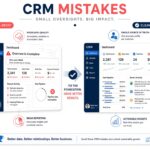
Common Mistakes to Avoid
- Buying more features than your team can absorb
- Migrating years of dirty data “just in case”
- Skipping process design
- Making the CRM the only source of truth before it is actually reliable
- Measuring success only by “we went live”
- Ignoring change management
- Letting AI agents run without guardrails or monitoring
Avoiding these is often more valuable than choosing a slightly better platform.
Final Takeaway
A successful CRM in 2026 is not the one with the longest feature list. It is the one your team uses consistently, that contains trustworthy data, and that is tied to clear business outcomes.
If you define the goals first, clean the data, implement in phases, invest in adoption, and measure results, the system becomes a genuine growth engine instead of an expensive database.
Start smaller than you think you need to. Get one process working well. Then expand. That disciplined approach consistently outperforms ambitious launches that never quite take hold.